Skip to content

Supporting Loved Ones in Addiction | Wed. March 25th

  • Online Recovery
    • Quit Opioids
    • Including prescription pain medication and heroin
    • Suboxone
    • Insurance or self-pay
    • At-home drug screenings
    • Quit Kratom
    • Including 7-OH
    • Medication assistance
    • Insurance or self-pay
    • Whole-person care (anxiety, insomnia, etc.)
    • Quit Drinking
    • Campral
    • Naltrexone
    • Insurance or self-pay
    • 100% Online
    • Non-judgmental providers
    • Help with co-occurring disorders​
    • Recovery groups
    • Real people (No AI bots)
  • About Us
    • Our Research

    Advancing substance use treatment through rigorous, peer-reviewed research and actionable insights.

    • Our Mission

    Everyone deserves access to the gold standard of treatment, without judgment.

    • Growing Our Team

    Join us in transforming addiction treatment and improving lives through digital care.

    • Founded and operated by people in recovery since 2015
  • Resources
    • 33% of members were referred by friends or family
    Free Help Them Heal Guide
    • Articles
    • Member stories
    • Opioid addiction help
    • Suboxone Basics
    • Quit drinking
    • Naltrexone basics
    • For friends and family
    • Workit Health
    • Insurance checker
    • Locations
    • Reviews
    • Resources
    • Mental health apps
    • Helplines and support
    • Community in recovery
    • Medication resources
    • 32k+ App store reviews
    • 35k+ Members
    • 85% of Workit clinicians have supported a loved one
  • Make A Referral
    • Friends and Family

    For friends or family members supporting someone they care about.

    • Partners and Providers

    For healthcare professionals making a patient referral.

    • 33% of members were referred by friends or family
  • Partners
Book now
  • Sobriety Tips and Tools, Stories Of Recovery
  • co-occurring disorders, depression, mental health, Recovery

What You Should Know About Self-Medicating Depression

  • Fact Checked and Peer Reviewed
  • By Olivia Pennelle

A future free of addiction is in your hands

Recover from addiction at home with medication, community, and support—from the nonjudmental experts who really care.

Get started today

What's your goal?

Join the 35k+ members who treated addiction via their phone

Close-up of a woman's smiling mouth. Her teeth are straight and white, and her long brown hair falls loose around her face.

Suboxone and Your Teeth

Alaine Sepulveda
A hand holds a Suboxone box up to the camera

A Dangerous Myth: “Suboxone is Just Legal Heroin”

Olivia Pennelle
A young man in a white t-shirt looks at himself in the mirror

Self-Care in Early Recovery

Alaine Sepulveda

In this article

I have struggled with depression for as long as I can remember. As a child, I didn’t know that’s what was happening. But looking back it’s pretty evident my depression dated back to childhood. The unfortunate reality is that I self-medicated my depression without proper intervention for about 25 years, ultimately leading to addiction. 

I remember not wanting to go to school as a child. This was usually on a Monday or Tuesday. School, social interactions, and getting out of my home felt overwhelming. So I’d often feign a stomachache and stay home. I didn’t have the words to describe what was happening to me, so I just appeared shy and a little withdrawn. What my family didn’t know is that I had begun self-medicating those feelings of hopelessness, lethargy, and lack of motivation. Initially, I did this with food, sneaking late-night snacks and eating when I was home alone, but later I progressed to using alcohol and drugs. 

Self-medicating is more common than you might think. According to the Substance Abuse and Mental Health Services Administration, approximately 7.7 million Americans suffer from co-occurring substance use disorders and mental health disorders (we often call this having a “dual diagnosis“). The most commonly reported mental health diagnoses are depressive disorders. Research also shows that trauma and alcohol misuse are also very common, especially with people who have PTSD.

What is depression?

According to the American Psychiatric Association (APA) depression is a common mental health disorder characterized by a low mood, loss of interest in daily activities, disruption to appetite, lethargy, feelings of worthlessness or sadness, wanting to sleep more, and lack of energy. These symptoms can significantly impact your day-to-day life, and your ability to function at home and work.

Depression affects one in 15 adults in any given year. One in six people will experience depression at some point in their life, however, it is most commonly experienced in teens to late 20s. The main risk factors for depression include genetics, a change in brain chemistry, those with low self-esteem or those who are generally overwhelmed by stress, as well as environmental triggers (such as violence, abuse, or neglect), which may make people more vulnerable to depression.

However, depression is treatable with medication, therapy, or a combination of the two. The APA advises that the first step is to see a family physician or psychiatrist.

Self-medication hypothesis

One important discussion is around the concept of using substances, particularly drugs, to cope with difficult feelings or mental illness as a form of self-medication. This process is more formally called the self-medication hypothesis, and was coined by Dr. Edward Khantzian from Harvard Medical School in 1987. 

Dr. Khantzian observed that people who used substances addictively chose those specific substances for the effects they had on the users. For example, opioids have a powerful muting and sedative effect. Conversely, cocaine relieves the distress associated with depression, hypomania, and hyperactivity. 

Similarly, certain foods, like gluten, can have an opioid-like effect on the brain, leading to pain relief and negative mental health effects. 

In my case, I used food, alcohol, and drugs to self-medicate my depression. By the time I was in my early 20s, I was showing signs of substance use disorder. Once I reached my 30s, my addiction had progressed to the acute phase and I desperately needed help. At that time, my days were a blur of depression and inebriation. Fortunately, those around me made me aware of the severe effects drugs and alcohol were having on my life, and I was able to find recovery at age 32. 

Signs of self-medicating

If you notice a change in behavior in a loved one (or in yourself) and worry that they might be self-medicating, here are some signs to watch out for:

  • Neglecting self-care, such as showering and getting dressed
  • Isolating from family, friends, and social events in preference for staying home alone
  • Experiencing difficulties at work or school 
  • Sudden mood changes, like anger or tearfulness
  • Secrecy about where they are spending their time

Of course, this is not an exhaustive list. The key thing to note is a sudden change in behavior and appearance. 

Risks of self-medicating

The main risks of self-medicating are deepening depression and other mental illnesses, like anxiety, the risk of developing substance use disorder, delays in seeking medical attention, adverse drug reactions, overdose, and masking more severe illnesses.

How to get help with self-medicating

If you or a loved one is struggling with mental illness and are self-medicating, there are a number of things you can do to get help:

  • Speak to your healthcare provider 
  • Seek therapy
  • Look into addiction treatment if you notice side effects when stopping medication
  • Speak to loved ones about your challenges and ask for their support
  • See what you can take off your plate while you get back on your feet
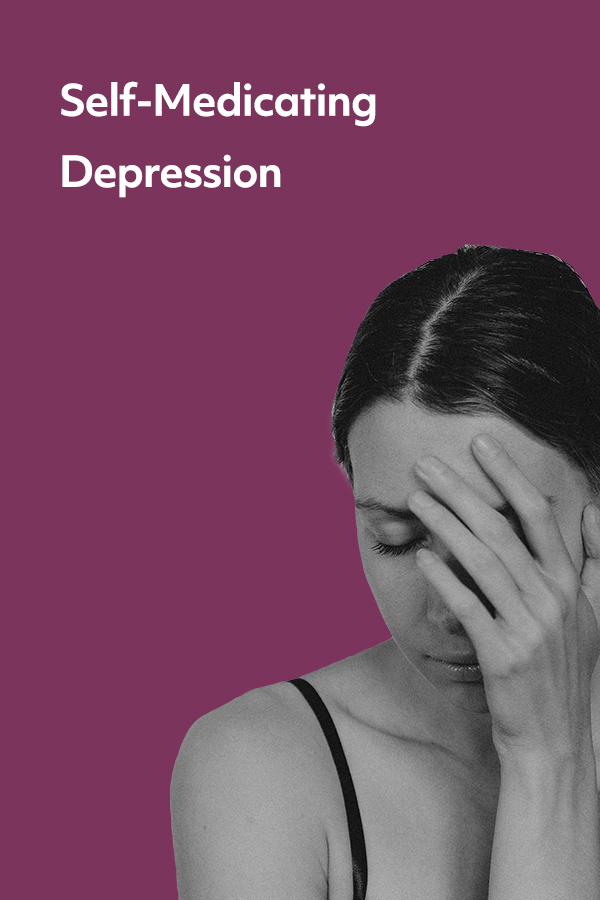
Self-medicating depression is common but full of pitfalls. Here is a look at self-medicating and how to get help.

Olivia Pennelle (Liv) has a masters in clinical social work from Portland State University. She is a mental health therapist, writer, and human activist. Her writing has appeared in STAT News, Insider, Filter Magazine, Ravishly, The Temper, and Shondaland. She is the founder of Liv’s Recovery Kitchen, Life After 12-Step Recovery, and Tera Collaborations. She lives near Portland, Oregon. Follow her on Instagram @Livwritesrecovery and @teracollaborations

PrevChange Unhealthy Habits We Developed During the Pandemic
Olympic Athletes in Addiction RecoveryNext

Any general advice posted on our blog, website, or app is for informational purposes only and is not intended to replace or substitute for any medical or other advice. Workit Health, Inc. and its affiliated professional entities make no representations or warranties and expressly disclaim any and all liability concerning any treatment, action by, or effect on any person following the general information offered or provided within or through the blog, website, or app. If you have specific concerns or a situation arises in which you require medical advice, you should consult with an appropriately trained and qualified medical services provider.

Top

Get the latest recovery news

Instagram Linkedin-in Facebook-f Youtube
    • Treatments
    • Opioids
    • Kratom
    • Alcohol


  • About Workit Health
  • Contact us
  • Our team
  • Media spotlight
  • Careers
  • We Accept Insurance
  • Check insurance
  • Aetna
  • Anthem of Ohio
  • Horizon BCBSNJ
  • Humana
  • Resources
  • What is harm reduction?
  • Addiction recovery resources
  • Suboxone FAQs
  • Blog
  • Friends and Family
  • Resources for friends and family
  • Help Them Heal Guide
  • Refer a loved one
  • Members
  • Login
  • Community
  • Medical records request form
  • Medical Records Fax: 833-923-0584
  • Tech support guides
  • Call us: 855-659-7734 M-F 8am-9pm EST
    • Partners
    • Make a referral
    • For health plans
    • For providers and hospitals
    • Third-party medical records requests
Treatments
    • Opioids
    • Kratom
    • Alcohol
About Us
  • Contact us
  • Our team
  • Media spotlight
  • Careers
Resources
  • What is harm reduction?
  • Addiction recovery resources
  • Suboxone FAQs
  • Blog
Insurance
  • Check insurance
  • Aetna
  • Anthem of Ohio
  • Horizon BCBSNJ
  • Humana
Members
  • Login
  • Community
  • Medical records request form
  • Medical Records Fax: 833-923-0584
  • Tech support guides
  • Call us: 855-659-7734
    M-F 8am-9pm EST
Resources
  • What is harm reduction?
  • Addiction recovery resources
  • Suboxone FAQs
  • Blog
Friends and Family
  • Resources for friends and family
  • Help Them Heal Guide
Partners
    • Make a referral
    • For health plans
    • For providers and hospitals
    • Third-party medical records requests
Locations
  • Arizona
  • California
  • Florida
  • Illinois
  • Michigan
  • Montana
  • New Jersey
  • New Mexico
  • North Carolina
  • Ohio
  • Oklahoma
  • Texas
  • Washington
Read more about Suboxone risks and concerns

Suboxone (buprenorphine/naloxone) is indicated for the treatment of opioid dependence in adults. Suboxone should not be taken by individuals who have been shown to be hypersensitive to buprenorphine or naloxone as serious adverse reactions, including anaphylactic shock, have been reported. Taking Suboxone (buprenorphine/naloxone) with other opioid medicines, benzodiazepines, alcohol, or other central nervous system depressants can cause breathing problems that can lead to coma and death. Other side effects may include headaches, nausea, vomiting, constipation, insomnia, pain, increased sweating, sleepiness, dizziness, coordination problems, physical dependence or abuse, and liver problems. For more information about Suboxone (buprenorphine/naloxone) see Suboxone.com, the full Prescribing Information, and Medication Guide, or talk to your healthcare provider. You are encouraged to report negative side effects of drugs to the FDA. Visit www.fda.gov/medwatch or call 1-800-FDA-1088.

All clinical and medical services are provided by licensed physicians and clinicians who are practicing as employees or contractors of independently owned and operated professional medical practices that are owned by licensed physicians. These medical practices include Workit Health (MI), PLLC; Workit Health (CA), P.C.; Workit Health (NJ), LLC; Workit Health (OH), LLC; Virtual Physician Practice (NY), PLLC; and any other Workit Health professional entity that is established in the future.

Clinic locations

Arizona
2501 N Hayden Rd.
Ste 103
Scottsdale, AZ 85257
fax (HIPAA): (833) 664-5441

California
1460 Maria Lane
Ste 300
Walnut Creek, CA 94596
fax (HIPAA): (855) 716-4494

Florida
600 Heritage Dr.
Ste 210, #17
Jupiter, FL 33458
fax (HIPAA): (813) 200-2822

Illinois
1280 Iroquois Ave
Ste 402
Naperville, IL 60563
fax (HIPAA): (855) 716-4494

Michigan
3300 Washtenaw Ave
Ste 280
Ann Arbor, MI 48104
fax (HIPAA): (855) 716-4494

Montana
415 N Higgins Ave
Ste 6
Missoula, MT 59802
fax (HIPAA): (855) 716-4494

New Jersey
5 Greentree Center
Ste 117
Marlton, NJ 08053
fax (HIPAA): (609) 855-5027

New Mexico
5901 Indian School Road, NE
Ste 212
Albuquerque, NM 87110
fax (HIPAA): (855) 716-4494

North Carolina
3719 Latrobe Drive
Ste 850-M
Charlotte, NC 28211-4827
fax (HIPAA): (855) 716-4494

Ohio
6855 Spring Valley Dr
Ste 110
Holland, OH 43528
fax (HIPAA): (513) 823-3247

Oklahoma
1010 24th Ave NW
Suite 100
Norman, OK 73069
fax (HIPAA): (855) 716-4494

Texas
5373 W Alabama St
Ste 204
Houston, TX 77056
fax (HIPAA): (737) 738-5046

Washington
9116 Gravelly Lake Dr SW
Ste 107 #3, PMB 1963
Lakewood, WA 98499-3148.
fax (HIPAA): (833) 328-1407

AICPA SOC

Terms of Service

Privacy Policy

Notice of Privacy Practice

View Accessibility Statement

© 2026 Workit Health. All rights reserved.

Not ready to start? We'll send you more information:

  • Workit Health

    When I opt in, Workit Health will send information about their program and recovery resources.

    *I agree to receive marketing and member care messages by email. Messaging frequency varies. I can unsubscribe at any time.

    **I agree to receive marketing and member care messages by text (SMS). Messaging frequency varies. Message and data rates may apply. I can opt out at any time by replying STOP. I can reply HELP to receive support. If I do not consent to receive SMS, and Workit Health is unable to reach me by email, I understand that they will not be able to contact me by text.

    Carriers are not liable for delayed or undelivered messages.

    View our Privacy Policy, Terms of Service, and Consent to SMS and Email.

  • Should be Empty:

This site uses cookies to improve your experience. By using this site, you consent to our use of cookies.

Accept Cookies