




Skip to content

Marc Lee Shannon Live in Concert | Wed. Nov. 19th

  • Online Recovery
    • Quit Opioids
    • Suboxone
    • Insurance or self-pay
    • At-home drug screenings
    • Quit Kratom
    • Medication assistance
    • Insurance or self-pay
    • Whole-person care (anxiety, insomnia, etc.)
    • Quit Drinking
    • Campral
    • Naltrexone
    • Insurance or self-pay
    • 100% Online
    • Non-judgmental providers
    • Help with co-occurring disorders​
    • Recovery groups
    • Real people (No AI bots)
  • About Us
    • Our Research

    Advancing substance use treatment through rigorous, peer-reviewed research and actionable insights.

    • Our Mission

    Everyone deserves access to the gold standard of treatment, without judgment.

    • Growing Our Team

    Join us in transforming addiction treatment and improving lives through digital care.

    • Founded and operated by people in recovery since 2015
  • Resources
    • Workit Health
    • Insurance checker
    • Locations
    • Reviews
    • Articles
    • Member stories
    • Opioid addiction help
    • Suboxone Basics
    • Quit drinking
    • Naltrexone basics
    • For friends and family
    • Resources
    • Help a loved one with addiction
    • Mental health apps
    • Helplines and support
    • Community in recovery
    • Medication resources
    • 32k+ App store reviews
    • 35k+ Members
    • 33% Referred by friends or family
  • Partners
  • Make A Referral
Book now
Book now
Book now
Login
  • Quit Opioids
  • Suboxone
  • Insurance or self-pay
  • At home drug screenings
  • Quit Kratom
  • Medication assistance
  • Insurance or self-pay
  • Whole-person care (anxiety, insomnia,etc.)
  • Quit Drinking
  • Medication assistance
  • Insurance or self-pay
  • Recovery groups
  • 100% Online
  • Non-judgmental providers
  • 35k+ Members
  • 3.2k+ Reviews
About Us
  • Our Research
  • Our Mission
  • Growing Our Team
Resources
  • Workit Health
  • Insurance checker
  • Locations
  • Reviews
  • Articles
  • Member stories
  • Opioid addiction help
  • Suboxone Basics
  • Quit drinking
  • Naltrexone basics
  • For friends and family
  • Resources
  • Help a loved one with addiction
  • Mental health apps
  • Helplines and support
  • Community in recovery
  • Medication resources
  • Partners
  • Make A Referral
  • Sobriety Tips and Tools
  • brain, triggers

What Are Addiction Triggers?

  • Fact Checked and Peer Reviewed
In recovery, people often refer to avoiding addiction triggers. What are triggers, and why do they matter?
  • By Kali Lux

A future free of addiction is in your hands

Recover from addiction at home with medication, community, and support—from the nonjudmental experts who really care.

Get started today

What's your goal?

Join the 35k+ members who treated addiction via their phone

In a dark space, a person wears a gleaming golden comedy mask and gestures widely with their arms.

Toxic Positivity vs. Healthy Optimism

Olivia Pennelle
A person's feet in brown hiking boots, standing in the snow.

Alone On Christmas: How To Cope If You Aren’t With Family Or Friends This Year

Kali Lux
New Mexico in the sunset

How to Find Drug Addiction Help in New Mexico

Alaine Sepulveda

In this article

In recovery, people often refer to avoiding addiction triggers. What are triggers, and why do they matter?

An addiction trigger can be anything that prompts memories, thoughts, or feelings that have to do with addiction.

How do addiction triggers work?

In order to fully understand addiction triggers, we must first understand how addiction rewires the reward circuitry in the brain. Our brains are programmed for survival. This means we naturally avoid pain (like fire) and seek out pleasure (like eating sweet, nutritious fruit). We feel good after we exercise or chat with a friend because these healthy behaviors affect us in a positive way, and we get a mild boost of feel-good chemicals in our brains from them. Addiction hijacks this natural reward circuitry, as drugs flood our brains with feel-good chemicals. Eventually, those of us with addiction become acclimated to these larger doses of chemical rewards, and will go to dramatic lengths to achieve a buzz.
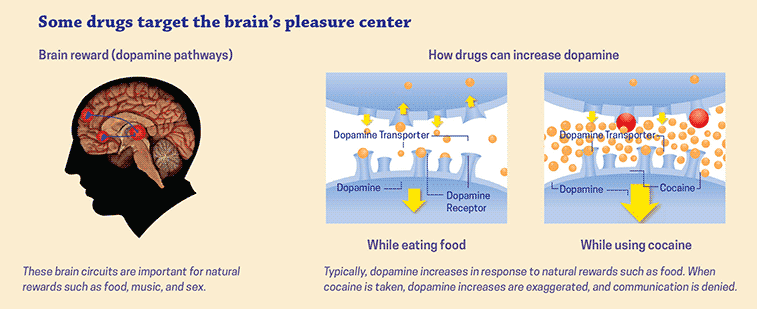
The illustration above, from NIDA shows how drugs can affect the feel-good chemicals in the brain.

As we begin to anticipate the big boosts of feel-good chemicals coming from our next fix, even the events and activities associated with the addictive behavior can cause changes in our brain. This is where triggers (or ‘cues,’ as they’re sometimes called in the science world) come in. Anything associated with the memories, thoughts, or feelings of addiction can be a trigger. It can cause your brain to reboot to the broken reward circuitry, resulting in cravings for drugs, alcohol, or behaviors even long after you’ve given them up.

Another thing to remember? In early recovery, the lack of extra feel-good chemicals coming from our substance or behavior of choice causes us to feel out-of-wack. Our brain stops making as many natural feel-good chemicals, because it’s accustomed to getting a boost from the substances we’ve been using. Samantha Panek, LLMSW, explains, “We’re especially desperate for feel-good chemicals in early recovery because they have become depleted. It’s like a flood of unbalanced emotions, feelings, and anxiety when people stop using.”

Why do addiction triggers matter?

Addiction can feel hopeless, but the more each of us understand about how addiction works, the better equipped we are to be active participants in our own recoveries. It can often feel like a relapse comes out of the blue, when in fact triggers led us towards it.

Identifying our own triggers, and learning to navigate through addiction triggers as a part of the recovery process, can help us avoid relapse and handle sticky situations. When we find ourselves craving our substance or behavior of choice, we can try to track back to recent events: how am I feeling? Did anything specific happen recently? We may find new insight about situations, people, or feelings that lead us back towards our addiction. Remember that even when we experience triggers, we still have the ability to make choices about how we respond to them. Encountering a trigger doesn’t force us to drink or use.

“We’re especially desperate for feel good chemicals in early recovery but especially low on them naturally. It’s like a flood of unbalanced emotions, feelings, and anxiety when people stop using.”

What are common addiction triggers?

Emotions: Both positive and negative emotions can be triggers for people in recovery. Why? For many of us, we masked our real emotions with our addiction of choice, and used substances or behaviors to cover them up whenever they would arise. This makes emotions, a natural aspect of human life, a trigger.

People, Places, & Things: If you drank in a specific bar every night, walking back into that bar in recovery will set your brain up to anticipate a drink. The same is true for the people that we used drugs, drank, or practiced behaviors with, and things like drug paraphernalia or even an old journal. This is why in early recovery, it is often encouraged to evaluate relationships and ensure you can avoid risky situations and environments.

I asked some friends in recovery about their own addiction triggers and how they cope with them. Robin, Workit Health’s Co-Founder, explained that “walking through the liquor aisle at the grocery store, family stress at the holidays, and sitting on the plane when the person next to me is drinking wine” are all triggers for her. She handles each of them differently: “I order groceries on Amazon Prime, if I’m on a flight I’ll ask to change seats or put on lots of scented moisturizer so I can’t smell the wine, and I reach out to my AA community for support during the holidays.”

My friend Lisa has trigger-mapping down to a science. Her triggers? “The afternoon energy slump, grief about the existence of death, conflict avoidance, holidays, evening chill time alone, jealousy and fear, being out of shape i.e. lethargic, awkward social networking events like happy hours that put me in a big group.” She keeps track of each of her triggers, along with the apps and tools she can use to combat them.

Our friend Corissa noted that along with drug paraphernalia, certain bands and musicians are triggering for her. She avoids listening to them in recovery, but says, “When they come on the radio or if someone else plays them, I can’t help but think of old times.“

So how can you cope with addiction triggers?

Addiction triggers sound scary. But understanding your triggers and finding healthy coping skills to manage your own emotions, instead of going back to your addiction, can be empowering.

For people and places, avoidance is a common solution. If you know certain people or places are triggering for you, then try to avoid those people or places. For other triggers, like emotions, avoidance isn’t an option. This is where healthy coping skills are crucial.

Common coping skills that can help you navigate triggers in recovery:

  • Talking with your support system, like a recovery coach or therapist, your sponsor, or supportive family members or friends.

  • Mindfulness, like taking five deep breaths, taking a walk around the block to unplug, or doing a five-minute meditation from your favorite meditation app.

  • Checking your HALT. HALT is an acronym that stands for Hungry, Angry, Lonely, and Tired, all feelings that can not only be triggering themselves, but can also make our defenses lower when facing other triggering emotions or events.

If this all sounds overwhelming, fear not. ust becoming aware of triggers and the way addiction has affected the reward circuitry of our brain is the first step towards positive change. Just reading about triggers, and gaining knowledge about how you can act differently when presented with them in the future, can set you up on the path for success.

Kali Lux is a consumer marketing leader with a focus on healthcare and wellness. She has over a decade of experience in building and operating metrics-driven brand, demand generation, and customer experience teams. A founding member of Workit Health’s team and a person in recovery herself, she’s passionate about fighting stigma and developing strategies that allow more people access to quality treatment at the moment they’re ready for help.

PrevWhen Anger and Fear Meet: Substance Use by Our Children
How to Administer NarcanNext

Any general advice posted on our blog, website, or app is for informational purposes only and is not intended to replace or substitute for any medical or other advice. Workit Health, Inc. and its affiliated professional entities make no representations or warranties and expressly disclaim any and all liability concerning any treatment, action by, or effect on any person following the general information offered or provided within or through the blog, website, or app. If you have specific concerns or a situation arises in which you require medical advice, you should consult with an appropriately trained and qualified medical services provider.

Top

Get the latest recovery news

Instagram Linkedin-in Facebook-f Youtube
  • Treatments
  • Opioids
  • Alcohol: Core Program
  • Alcohol: Flex Program
  • About Workit Health
  • Contact us
  • Our team
  • Media spotlight
  • Careers
  • We Accept Insurance
  • Check insurance
  • Aetna
  • Anthem of Ohio
  • Horizon BCBSNJ
  • Humana
  • Resources
  • What is harm reduction?
  • Addiction recovery resources
  • Suboxone FAQs
  • Blog
  • Friends and Family
  • Resources for friends and family
  • Help Them Heal Guide
  • Members
  • Login
  • Community
  • Request medical records
  • Tech support guides
  • Call us: 855-659-7734 M-F 8am-9pm EST
    • Partners
    • Make a referral
    • For health plans
    • For providers and hospitals
    • Third-party medical records requests
Read more about Suboxone risks and concerns

Suboxone (buprenorphine/naloxone) is indicated for the treatment of opioid dependence in adults. Suboxone should not be taken by individuals who have been shown to be hypersensitive to buprenorphine or naloxone as serious adverse reactions, including anaphylactic shock, have been reported. Taking Suboxone (buprenorphine/naloxone) with other opioid medicines, benzodiazepines, alcohol, or other central nervous system depressants can cause breathing problems that can lead to coma and death. Other side effects may include headaches, nausea, vomiting, constipation, insomnia, pain, increased sweating, sleepiness, dizziness, coordination problems, physical dependence or abuse, and liver problems. For more information about Suboxone (buprenorphine/naloxone) see Suboxone.com, the full Prescribing Information, and Medication Guide, or talk to your healthcare provider. You are encouraged to report negative side effects of drugs to the FDA. Visit www.fda.gov/medwatch or call 1-800-FDA-1088.

All clinical and medical services are provided by licensed physicians and clinicians who are practicing as employees or contractors of independently owned and operated professional medical practices that are owned by licensed physicians. These medical practices include Workit Health (MI), PLLC; Workit Health (CA), P.C.; Workit Health (NJ), LLC; Workit Health (OH), LLC; Virtual Physician Practice (NY), PLLC; and any other Workit Health professional entity that is established in the future.

Clinic locations

Arizona
9700 N. 91st. St.
Ste A-115
Scottsdale, AZ 85258
fax (HIPAA): (833) 664-5441

California
1460 Maria Lane
Ste 300
Walnut Creek, CA 94596
fax (HIPAA): (855) 716-4494

Florida
600 Heritage Dr.
Ste 210, #17
Jupiter, FL 33458
fax (HIPAA): (813) 200-2822

Illinois
1280 Iroquois Ave
Ste 402
Naperville, IL 60563
fax (HIPAA): (855) 716-4494

Michigan
3300 Washtenaw Ave
Ste 280
Ann Arbor, MI 48104
fax (HIPAA): (855) 716-4494

Montana
415 N Higgins Ave
Ste 6
Missoula, MT 59802
fax (HIPAA): (855) 716-4494

New Jersey
5 Greentree Center
Ste 117
Marlton, NJ 08053
fax (HIPAA): (609) 855-5027

New Mexico
5901 Indian School Road, NE
Ste 212
Albuquerque, NM 87110
fax (HIPAA): (855) 716-4494

Ohio
6855 Spring Valley Dr
Ste 110
Holland, OH 43528
fax (HIPAA): (513) 823-3247

Oklahoma
1010 24th Ave NW
Suite 100
Norman, OK 73069
fax (HIPAA): (855) 716-4494

Texas
5373 W Alabama St
Ste 204
Houston, TX 77056
fax (HIPAA): (737) 738-5046

Washington
9116 Gravelly Lake Dr SW
Ste 107 #3, PMB 1963
Lakewood, WA 98499-3148.
fax (HIPAA): (833) 328-1407

AICPA SOC

Terms of Service

Privacy Policy

Notice of Privacy Practice

View Accessibility Statement

© 2025 Workit Health. All rights reserved.

Your recovery, your way—
100% online

Book your appointment
Check your insurance coverage
  • Aetna
  • Humana
  • Horizon
  • Cigna
  • Blue Cross Blue Shield
  • and more

👉 Using insurance? Coverage checks are always for free in the Workit Health app.

Check your coverage

Not ready to start? We'll send you more information:

  • *Messaging frequency varies. I can unsubscribe at any time.

    **Messaging frequency varies. Message and data rates may apply. I can opt out at any time by replying STOP. I can reply HELP to receive support. If I do not consent to receive SMS, and Workit Health is unable to reach me by email, I understand that they will not be able to contact me by text.

    View our Privacy Policy, Terms of Service, and Consent to SMS and Email.

  • Should be Empty:

This site uses cookies to improve your experience. By using this site, you consent to our use of cookies.

Accept Cookies