Skip to content

Marc Lee Shannon Live in Concert | Wed. Nov. 19th

  • Online Recovery
    • Quit Opioids
    • Suboxone
    • Insurance or self-pay
    • At-home drug screenings
    • Quit Kratom
    • Medication assistance
    • Insurance or self-pay
    • Whole-person care (anxiety, insomnia, etc.)
    • Quit Drinking
    • Campral
    • Naltrexone
    • Insurance or self-pay
    • 100% Online
    • Non-judgmental providers
    • Help with co-occurring disorders​
    • Recovery groups
    • Real people (No AI bots)
  • About Us
    • Our Research

    Advancing substance use treatment through rigorous, peer-reviewed research and actionable insights.

    • Our Mission

    Everyone deserves access to the gold standard of treatment, without judgment.

    • Growing Our Team

    Join us in transforming addiction treatment and improving lives through digital care.

    • Founded and operated by people in recovery since 2015
  • Resources
    • Workit Health
    • Insurance checker
    • Locations
    • Reviews
    • Articles
    • Member stories
    • Opioid addiction help
    • Suboxone Basics
    • Quit drinking
    • Naltrexone basics
    • For friends and family
    • Resources
    • Help a loved one with addiction
    • Mental health apps
    • Helplines and support
    • Community in recovery
    • Medication resources
    • 32k+ App store reviews
    • 35k+ Members
    • 33% Referred by friends or family
  • Partners
  • Make A Referral
Book now
Book now
Book now
Login
  • Quit Opioids
  • Suboxone
  • Insurance or self-pay
  • At home drug screenings
  • Quit Kratom
  • Medication assistance
  • Insurance or self-pay
  • Whole-person care (anxiety, insomnia,etc.)
  • Quit Drinking
  • Medication assistance
  • Insurance or self-pay
  • Recovery groups
  • 100% Online
  • Non-judgmental providers
  • 35k+ Members
  • 3.2k+ Reviews
About Us
  • Our Research
  • Our Mission
  • Growing Our Team
Resources
  • Workit Health
  • Insurance checker
  • Locations
  • Reviews
  • Articles
  • Member stories
  • Opioid addiction help
  • Suboxone Basics
  • Quit drinking
  • Naltrexone basics
  • For friends and family
  • Resources
  • Help a loved one with addiction
  • Mental health apps
  • Helplines and support
  • Community in recovery
  • Medication resources
  • Partners
  • Make A Referral
  • For Friends And Family, Opioid Addiction Help
  • addiction, family, resources

Resources for the Families of Those Suffering with Addiction

  • Fact Checked and Peer Reviewed

Unfortunately, substance use disorder doesn’t affect just one type of person — it impacts people in all walks of life, and most of them have families. It is a serious national public health problem affecting approximately 45 million families.

  • By Olivia Pennelle

Concerned about a loved one?​

Download our free guide about how to better support a loved one with substance use disorder.

Free Help Them Heal Guide (PDF)

What's your goal?

Join the 35k+ members who treated addiction via their phone

Snowy mountain peaks beneath a clear blue sky.

Why Try Dry January?

Alaine Sepulveda
Several doctors, masked for surgery, stand in a circle, staring down at the camera.

How to Advocate for Yourself With Medical Providers

Olivia Pennelle
Cubes with letters on them spell out the word Why

Discover Your Why (Why You’re Taking a Break From Booze)

Tawny Lara

In this article

Substance use disorder doesn’t affect just one type of person—it impacts people in all walks of life, and most of them have families.

Substance use disorder (SUD) is a serious national public health problem affecting approximately 45 million families. Individually, 21 million people have a substance use disorder and 17 million have alcohol use disorder. These statistics have devastating consequences.

According to the Centers for Disease Control and Prevention, a staggering 64,000 people died from drug overdoses each year. 88,000 died from alcohol-related causes.

Addiction is a family disease because it affects the whole family: it wreaks havoc in the household environment and in familial/romantic relationships. A family home that should be loving and nurturing can become stressful and confusing, and positive values are often replaced with distrust, frustration, and resentment. Having a family member with addiction also places children at risk of developing issues with substance use, as well as mental and physical problems in their teens and later life.

We call addiction a disease because it is progressive and—if left untreated—only continues to worsen over time. But it doesn’t have to be that way. Over 23 million Americans live in long-term recovery, and have successfully resolved a drug or alcohol problem. This kind of change does, however, require the family to seek recovery together.

How we can support loved ones with substance use disorder:

We can support loved ones struggling with addiction—wherever they are in their recovery journey—in a number of ways:

  • Intervention. If the person refuses to seek help but is causing significant disruption within the family, and you fear for their safety and that of you and the family, it might be helpful to arrange an intervention.

  • Understanding SUD. Learn about substance use disorder to better understand that it is a medical condition. If a person with SUD feels punished or shamed for their behavior, it can push them away, even if you are trying to help.

  • Being supportive of recovery. Support a loved one’s decision to seek formal treatment, whether that is best achieved through a mutual-aid meeting or inpatient rehabilitation.

  • Make time for recovery. Be available to speak to family members when they are in treatment. Set aside time for them and show your support.

  • Seek your own recovery. Whether you realize it or not, you will also need help to recover while your loved one is seeking treatment. You may need help to create and enforce healthy boundaries, learn how to make your care a priority and how to put yourself first, and understand the role addiction plays in a relationship. Finding that help may come through professional therapeutic support, or through a mutual-aid program.

  • Work together as a family to support long-term recovery. This involves managing expectations, attending family therapy, sharing household tasks, allowing time for continued recovery activities, trying to do things together as a family like taking walks and eating a meal together, and trying to implement healthy routines like regular sleeping patterns and healthy eating.

  • Language matters. Be conscious of the language you use to describe substance use disorder. Refrain from using stigmatizing terms like “addict,” “alcoholic,” “clean,” and “relapse.” It’s best to use person-centered language. See below for a helpful guide
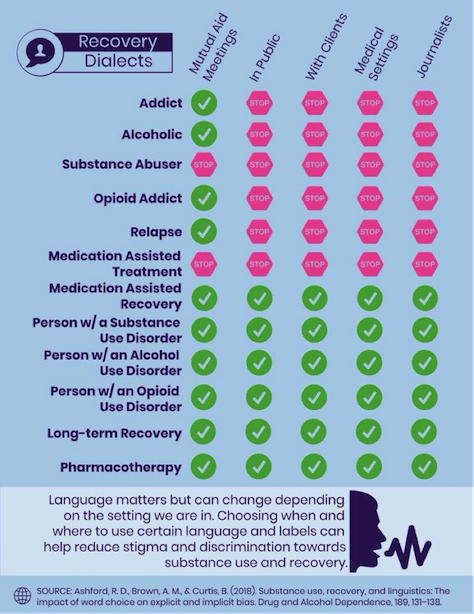
Information and resources are available.

There are a lot of resources out there for families and partners of loved ones suffering from substance use disorders. It can be hard to differentiate between them, so we’ve categorized them into helpful sections:

Education & Information:

  • The National Institute on Drug Abuse has provided helpful, easy-to-read drug facts. There is also a sister site specifically about alcohol and alcohol use disorder: NIAAA.

  • The Substance Abuse and Mental Health Services Administration also has a website with a library of free resources and publications, including pamphlets for families where addiction is present, information on family therapy, and what is involved in substance use disorder treatment.

  • For parents and teachers: American Academy of Child and Adolescent Psychiatry resource center and NIHA Parents and Educators Resources

  • For physicians and clinicians: American Academy of Child and Adolescent Psychiatry on substance use disorders, American Academy of Family Physicians on opioid use disorder, and the American Society of Addiction Medicine

Interventions:

The most common interventions used by practitioners are ARISE and the Johnson model.

Online support groups:

Facebook has a host of recovery support groups for families, including Voices to End Addiction & Inspire Recovery, FamilyRx, as well as online versions of mutual-aid meetings.

Helpful organizations:

  • Recovery Community Organization (RCO): Faces & Voices of Recovery—they also have a list of RCOs, the Association of Recovery Community Organizations.

  • For parents with children struggling with addiction: Family Resource Center and Partnership to End Addiction.

  • For information on mental illness: National Alliance on Mental Illness

  • Recovery housing: the National Alliance of Recovery Residences

  • The Association of Recovery in Higher Education

  • The Association of Recovery High Schools

In-person support groups and information:

  • For children and teens: Alateen

  • Alanon

  • Adult Children of Alcoholics

  • SMART Recovery Friends and Family

Finding treatment:

  • NIAAA treatment locator for alcohol use disorder

  • SAMHSA treatment program locator for opioid use disorder

  • SAMHSA medication-assisted recovery locator

Mutual-aid support for the person suffering from substance use disorder:

If your loved one doesn’t go to treatment or wants to supplement their therapy with a peer-based support group, they can go to any number of mutual-aid groups, including:

  • Refuge Recovery

  • Recovery Dharma (a splinter group from Refuge Recovery)

  • SMART Recovery

  • LifeRing Secular Recovery

  • Transforming Youth Recovery

  • Moderation Management

  • Secular Organizations for Sobriety

  • Alcoholics Anonymous

  • Women for Sobriety

  • Narcotics Anonymous

There are also religious and culturally specific groups that individuals can attend, including:

  • Wellbriety Movement (Indigenous spiritual traditions)

  • Celebrate Recovery (Christian)

  • Millati Islami (Muslim)

  • Jewish Alcoholics, Chemically Dependent Persons, and Significant Others (Jewish)

Olivia Pennelle (Liv) has a masters in clinical social work from Portland State University. She is a mental health therapist, writer, and human activist. Her writing has appeared in STAT News, Insider, Filter Magazine, Ravishly, The Temper, and Shondaland. She is the founder of Liv’s Recovery Kitchen, Life After 12-Step Recovery, and Tera Collaborations. She lives near Portland, Oregon. Follow her on Instagram @Livwritesrecovery and @teracollaborations

Prev5 Ways Exercise Boosts Your Chances of Long-Term Sobriety
Addiction and Suicide: Take a Minute, Save a LifeNext

Any general advice posted on our blog, website, or app is for informational purposes only and is not intended to replace or substitute for any medical or other advice. Workit Health, Inc. and its affiliated professional entities make no representations or warranties and expressly disclaim any and all liability concerning any treatment, action by, or effect on any person following the general information offered or provided within or through the blog, website, or app. If you have specific concerns or a situation arises in which you require medical advice, you should consult with an appropriately trained and qualified medical services provider.

Top

Get the latest recovery news

Instagram Linkedin-in Facebook-f Youtube
  • Treatments
  • Opioids
  • Alcohol: Core Program
  • Alcohol: Flex Program
  • About Workit Health
  • Contact us
  • Our team
  • Media spotlight
  • Careers
  • We Accept Insurance
  • Check insurance
  • Aetna
  • Anthem of Ohio
  • Horizon BCBSNJ
  • Humana
  • Resources
  • What is harm reduction?
  • Addiction recovery resources
  • Suboxone FAQs
  • Blog
  • Friends and Family
  • Resources for friends and family
  • Help Them Heal Guide
  • Members
  • Login
  • Community
  • Request medical records
  • Tech support guides
  • Call us: 855-659-7734 M-F 8am-9pm EST
    • Partners
    • Make a referral
    • For health plans
    • For providers and hospitals
    • Third-party medical records requests
Read more about Suboxone risks and concerns

Suboxone (buprenorphine/naloxone) is indicated for the treatment of opioid dependence in adults. Suboxone should not be taken by individuals who have been shown to be hypersensitive to buprenorphine or naloxone as serious adverse reactions, including anaphylactic shock, have been reported. Taking Suboxone (buprenorphine/naloxone) with other opioid medicines, benzodiazepines, alcohol, or other central nervous system depressants can cause breathing problems that can lead to coma and death. Other side effects may include headaches, nausea, vomiting, constipation, insomnia, pain, increased sweating, sleepiness, dizziness, coordination problems, physical dependence or abuse, and liver problems. For more information about Suboxone (buprenorphine/naloxone) see Suboxone.com, the full Prescribing Information, and Medication Guide, or talk to your healthcare provider. You are encouraged to report negative side effects of drugs to the FDA. Visit www.fda.gov/medwatch or call 1-800-FDA-1088.

All clinical and medical services are provided by licensed physicians and clinicians who are practicing as employees or contractors of independently owned and operated professional medical practices that are owned by licensed physicians. These medical practices include Workit Health (MI), PLLC; Workit Health (CA), P.C.; Workit Health (NJ), LLC; Workit Health (OH), LLC; Virtual Physician Practice (NY), PLLC; and any other Workit Health professional entity that is established in the future.

Clinic locations

Arizona
9700 N. 91st. St.
Ste A-115
Scottsdale, AZ 85258
fax (HIPAA): (833) 664-5441

California
1460 Maria Lane
Ste 300
Walnut Creek, CA 94596
fax (HIPAA): (855) 716-4494

Florida
600 Heritage Dr.
Ste 210, #17
Jupiter, FL 33458
fax (HIPAA): (813) 200-2822

Illinois
1280 Iroquois Ave
Ste 402
Naperville, IL 60563
fax (HIPAA): (855) 716-4494

Michigan
3300 Washtenaw Ave
Ste 280
Ann Arbor, MI 48104
fax (HIPAA): (855) 716-4494

Montana
415 N Higgins Ave
Ste 6
Missoula, MT 59802
fax (HIPAA): (855) 716-4494

New Jersey
5 Greentree Center
Ste 117
Marlton, NJ 08053
fax (HIPAA): (609) 855-5027

New Mexico
5901 Indian School Road, NE
Ste 212
Albuquerque, NM 87110
fax (HIPAA): (855) 716-4494

Ohio
6855 Spring Valley Dr
Ste 110
Holland, OH 43528
fax (HIPAA): (513) 823-3247

Oklahoma
1010 24th Ave NW
Suite 100
Norman, OK 73069
fax (HIPAA): (855) 716-4494

Texas
5373 W Alabama St
Ste 204
Houston, TX 77056
fax (HIPAA): (737) 738-5046

Washington
9116 Gravelly Lake Dr SW
Ste 107 #3, PMB 1963
Lakewood, WA 98499-3148.
fax (HIPAA): (833) 328-1407

AICPA SOC

Terms of Service

Privacy Policy

Notice of Privacy Practice

View Accessibility Statement

© 2025 Workit Health. All rights reserved.

Your recovery, your way—
100% online

Book your appointment
Check your insurance coverage
  • Aetna
  • Humana
  • Horizon
  • Cigna
  • Blue Cross Blue Shield
  • and more

👉 Using insurance? Coverage checks are always for free in the Workit Health app.

Check your coverage

Not ready to start? We'll send you more information:

  • *Messaging frequency varies. I can unsubscribe at any time.

    **Messaging frequency varies. Message and data rates may apply. I can opt out at any time by replying STOP. I can reply HELP to receive support. If I do not consent to receive SMS, and Workit Health is unable to reach me by email, I understand that they will not be able to contact me by text.

    View our Privacy Policy, Terms of Service, and Consent to SMS and Email.

  • Should be Empty:

This site uses cookies to improve your experience. By using this site, you consent to our use of cookies.

Accept Cookies