Skip to content

Workit Health Presents: A Dopey Interview of Amy Dresner · Live on YouTube · June 10, 2026 · 7pm est

  • Treatments
    • Opioid Use Disorder

    Start Suboxone treatment online with a licensed provider without judgment.

    • Alcohol Use Disorder

    Flexible goals — moderation or abstinence. Evidence-based, no 12-step requirement

    • Kratom & 7-OH

    Medication options that actually work for withdrawals and cravings.

    Anxiety · Depression · Insomnia · Hepatitis C · And more

    Substance use often goes hand-in-hand with other conditions. Your provider can prescribe for many of these, including anxiety, depression, and insomnia—so you can get back on solid ground. They can even treat hepatitis C and prescribe PrEP for HIV prevention.

    Start treatment
  • Pricing
  • Locations

    Available now

    • Arizona
    • California
    • Florida
    • Illinois
    • Michigan
    • Montana
    • New Jersey
    • New Mexico
    • New York
    • North Carolina
    • Ohio
    • Oklahoma
    • Texas
    • Washington
    Get notified if we open in your state
  • Reviews
  • About
    • About Workit Health

    Our mission, founders, and clinical team.

    • Workit Labs · Research

     Peer-reviewed publications on telehealth addiction care.

    • Blog

    Plain language guides on recovery, medication, and family-support.

    • Careers

    Join the team building the future of addiction care

  • Help Someone
Login
Get started
Get started
  • Login to my account
Treatments
  • Opioid use disorder
  • Suboxone
  • Alcohol use disorder
  • Kratom & 7-OH dependency

whole person care included

Substance use often goes hand-in-hand with other conditions. Your provider can prescribe for many of these, including anxiety, depression, insomnia, hepatitis C, and more—so you can get back on solid ground.

  • Insurance or Self-pay
Locations
  • Arizona
  • California
  • Florida
  • Illinois
  • Michigan
  • Montana
  • New Jersey
  • New Mexico
  • New York
  • North Carolina
  • Ohio
  • Oklahoma
  • Texas
  • Washington
  • Reviews
About
  • About Workit Health
  • Workit Labs · Research
  • Blog
  • Careers
  • Refer a friend
  • Help Someone
Get started

In crisis? Call or text: 988

Home > Blog > 5 Ways I’ve Changed My Mind At 10 Years Sober

  • Sobriety Tips and Tools

5 Ways I’ve Changed My Mind At 10 Years Sober

Ten years ago, I didn’t want to live a better life. I didn’t want to grow as a person. I just wanted to not wake up in withdrawal from pills and to stop nodding out at work.

BY

  • Kali Lux

UPDATED

  • June 19, 2019
  • Fact-checked & medically reviewed

on this page

I recently celebrated ten years in recovery from drug and alcohol addiction. I’ve come a long way from the young woman who spent her 21st birthday in rehab, celebrating with a sugar-free cake and agonizing over parties I was missing.

Ten years ago, I didn’t want to live a better life. I didn’t want to grow as a person. I just wanted to not wake up in withdrawal from pills and to stop nodding out at work.

If you’re not sure you can quit or change your relationship with substances, I’ve been there. I swore off pills or booze many times, just to find myself falling back into their traps. I tried on several walked down several different paths to recovery before I found one that felt right for me.

Along the way, I experienced some serious paradigm shifts. A paradigm shift is a scientific term used to describe when an old way doesn’t work with a new experience, resulting in a change of your basic perception of events.

Here are 5 big shifts in understanding that helped me on my journey to recovery:

1. A growth mindset works better.

When I’m insistent about my beliefs, habits, and understanding of the world, my mindset is fixed. In a growth mindset, I understand that I can cultivate who I am, and my knowledge and personality aren’t fixed traits attached to my self-worth. I don’t always have to win arguments or be the best at everything when I’m living in a growth mindset.

I spent many of my first few years of recovery finding out who I was. This felt so empowering and rewarding — but then I found myself limited by the new constraints I’d set up for myself. I slowly learned this person I’d decided to be could grow and change. This growth mindset helps me understand other people’s viewpoints, be open to feedback, and be more curious about the world around me.
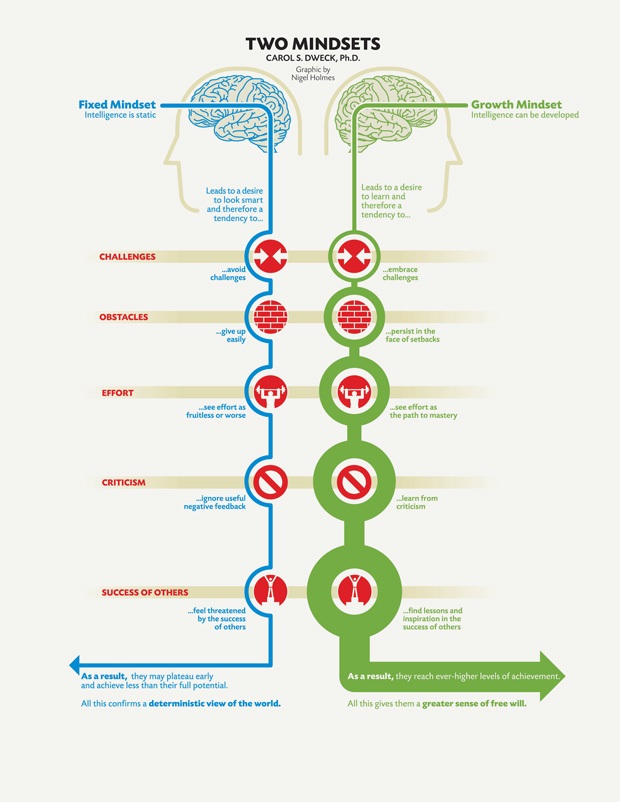
Want to learn more about the whole growth mindset thing? Check out Carol Dweck’s TED talk on The Power of Believing You Can Improve.

2. Every expert was once a beginner.

I tend to give up on things I’m not good at. And like most people, I’m not good at a lot of things when I’m first learning them — including how to live life sober. But no one is good at anything when they’re starting out. We all start somewhere.

In Daniel Coyle’s book The Talent Code, he explains that we often perceive people as talented when they’re just devoted to deep practice, and open to a growth mindset. People aren’t born experts or natural talents — they just haven’t given up, and their persistence and practice has paid off.

Coyle explains that the uncomfortable edge of practice where you make mistakes (exactly where I’m tempted to quit) is where the learning and growth really happens. He explains, “The truth is, when you are starting out, you do not ‘play’ tennis; you struggle and fight and pay attention and slowly get better. The truth is, we learn in staggering-baby steps. Effort-based language works because it speaks directly to the core of the learning experience.” Learning how to do anything, from living without drugs to playing tennis, is hard. It’s uncomfortable.

I don’t like to feel uncomfortable. I drank and did drugs to avoid feeling discomfort. But what I’ve learned in recovery is that discomfort is where the growth happens, and where I’m able to learn. If I’m uncomfortable, it’s probably an opportunity. And I have a lot of opportunities.

3. I’m not defined by my thoughts and feelings.

In early recovery (and when I was still drinking and using), I was terrified of my emotions. Feeling anxiety or depression would literally overcome me, and at times I tried to kill myself overcome with alcohol, lack of inhibition, and emotion.

Meditation helped me watch my thoughts and emotions come and go — in early recovery, my 12-step friends dragged me to Dharma Punx meetings, where I struggled to sit through agonizing silent meditations. But gradually, I began to absorb some of the lessons. I watched my thoughts come and go, seemingly at random. I brought curiosity to the physical experience of my anxiety. In Daniel J Siegel’s book Mindsight, he explains, “Inviting our thoughts and feelings into awareness allows us to learn from them rather than be driven by them.” He compares the experience of saying “I am sad,” to the experience of saying “I feel sad,” — when I’m saying I’m sad, I’m declaring this as a part of me. When I’m saying I feel sad, like feeling cold or tired, I’m acknowledging the impermanence of emotional states and myself as something separate from them.

Want to learn more? Check out Daniel Siegel’s Mindsight meditation on Youtube.

“I can’t expect my life to play out like a montage scene in a movie unless I get up and take some action.”

4. My mind is a scary place, but that doesn’t mean I can’t go there.

In rehab, we’re often taught that our minds are dangerous places to explore or that we can’t trust our own thinking. I believe this simple messaging serves people in early recovery, as my thinking used to be overwhelmingly negative. But a decade in, it no longer serves me to think of my mind as a dangerous place to go. Cognitive Behavioral Therapy techniques like the ones used in Workit’s online addiction courses helped me realize that I do have negative thought patterns — but I also have the power to recognize and change these patterns.

Not sure what Cognitive Behavioral Therapy is? You can learn negative thinking patterns and how to fix them in a course unlocked from Workit Health’s Program, Owning Your Auto Thoughts.

5. It’s okay to be sensitive.

I used to pride myself on being able to keep up with a wild party lifestyle. I came of age at a time when ‘Hardcore’ was an adjective used to describe coolness, and I spent much of my youth trying to be hardcore. In recovery, I’ve realized that I drank and used because I was uncomfortable much of the time. When I took away the blurring filter of drugs and alcohol, small details of my environment began to matter more. The clothes I wore, the noise and scents in the environment around me — all of this affects me more than I wanted to admit.

I’ve now realized that I’m likely a Highly Sensitive Person, and I believe many people who struggle with addiction are. In Elaine N Aron’s book, she explains, “Highly Sensitive People are a package deal. Our trait of sensitivity means we will also be cautious, inward, needing extra time alone. Because people without the trait (the majority) do not understand that, they see us as timid, shy, weak, or the greatest sin of all, unsociable. Fearing these labels, we try to be like others. But that leads to our becoming over-aroused and distressed. Then that gets us labeled neurotic or crazy, first by others and then by ourselves.”

This vicious cycle of trying to keep up with the pack, burning out, and then labeling myself as crazy was how I spent much of my twenties. I’ve stopped being ashamed of my sensitivity, or trying to bury it unsuccessfully under booze and pills.

—

I can’t expect my life to play out like a montage scene in a movie unless I get up and take some action. In the past, I waited for some perfect moment or sort of sign, and now I realize I would have been waiting forever, stuck in a mess of unhappy habits.

Did I understand any of this when I decided that I’d had enough of the endless cycle of drug addiction? Did I want to open my mind and grow as a person? Naw, man. I wanted to detox and get back to my life as normal, without rocking my perilous little boat. We never want to rock our boats–change can feel terrifying and like we’re losing a part of ourselves–and it’s often just the thing to save our lives.

PrevpreviousRoutines That Help Me Stay on Track in Recovery
nextHow Support Groups Help Me Cope With My Loved Ones AddictionNext

on this page

need help?

Stop the cycle of cravings and withdrawal

  • Suboxone prescribed online*
  • Most major insurance accepted
  • $25–$35/mo with insurance
  • ~2 days to first appointment

*as clinically appropriate

Download the app →

Learn about treatment

PrevpreviousRoutines That Help Me Stay on Track in Recovery
nextHow Support Groups Help Me Cope With My Loved Ones AddictionNext

ABOUT THE AUTHOR

Kali Lux is a consumer marketing leader with a focus on healthcare and wellness. She has over a decade of experience in building and operating metrics-driven brand, demand generation, and customer experience teams. A founding member of Workit Health’s team and a person in recovery herself, she’s passionate about fighting stigma and developing strategies that allow more people access to quality treatment at the moment they’re ready for help.

ready when you are​

Download the app. Get back to yourself.

Sign up takes about 5 minutes. Most members have their first appointment within 2 days. Covered by most insurance.

Download the app
Learn more

KEEP READING

Why Is Suboxone Taken Sublingually?

Many medications are swallowed, but Suboxone (buprenorphine/naloxone) is taken under the tongue (sublingually) or on the cheek (buccally).

Read now

5 Questions About Online Suboxone Treatment, Answered

Workit Health treats opioid addiction with medication like Suboxone online via telehealth. How do we do it? In this post, we answer several common questions.

Read now

5 Sneaky Alcohol Myths and the Truth Behind Them

If you’ve drink at all, you’ve likely heard rumors and myths about alcohol and hangovers. Let’s go beyond the myths to face facts.

Read now

Any general advice posted on our blog, website, or app is for informational purposes only and is not intended to replace or substitute for any medical or other advice. Workit Health, Inc. and its affiliated professional entities make no representations or warranties and expressly disclaim any and all liability concerning any treatment, action by, or effect on any person following the general information offered or provided within or through the blog, website, or app. If you have specific concerns or a situation arises in which you require medical advice, you should consult with an appropriately trained and qualified medical services provider.

100% virtual addiction treatment for opioid, alcohol, and kratom use disorders. Evidence-based medication, therapy, and recovery support—from your phone.

hello@workithealth.com

Instagram Linkedin-in Facebook-f Youtube
    • TREATMENTS
    • Opioids
    • Kratom & 7-OH
    • Alcohol
    • Insurance & Cost
    • Locations
    • Get started
    • HELP SOMEONE
    • Help a loved one
    • Refer a friend
    • Recovery blog
    • Narcan guide
    • FAQ
    • COMPANY
    • About
    • Workit Labs · Research
    • Careers
    • Partnerships
    • Contact
    • MEMBERS
    • Login
    • Create account
    • Refer a friend
    • Medical records request form
    • Fax: 833-923-0584
    • Phone: 855-659-7734
AICPA SOC
  • 42 CFR Part 2
  • WCAG 2.1 AA

contact information

Arizona
2501 N Hayden Rd.
Ste 103
Scottsdale, AZ 85257
fax (HIPAA): (833) 664-5441

California
1460 Maria Lane
Ste 300
Walnut Creek, CA 94596
fax (HIPAA): (833) 244-6705

Florida
600 Heritage Dr.
Ste 210, #17
Jupiter, FL 33458
fax (HIPAA): (813) 200-2822

Illinois
1280 Iroquois Ave
Ste 402
Naperville, IL 60563
fax (HIPAA): (833) 664-8715

Michigan
3300 Washtenaw Ave
Ste 280
Ann Arbor, MI 48104
fax (HIPAA): (855) 716-4494

Montana
415 N Higgins Ave
Ste 6
Missoula, MT 59802
fax (HIPAA): (833) 664-5486

New Jersey
5 Greentree Center
Ste 117
Marlton, NJ 08053
fax (HIPAA): (609) 855-5027

New Mexico
5901 Indian School Road, NE
Ste 212
Albuquerque, NM 87110
fax (HIPAA): (833) 664-5701

New York
845 Central Avenue
Ste 204
Albany, NY 12206
fax (HIPAA): (844) 921-1079

North Carolina
3719 Latrobe Drive
Ste 850-M
Charlotte, NC 28211-4827
fax (HIPAA): (984) 375-6710

Ohio
6855 Spring Valley Dr
Ste 110
Holland, OH 43528
fax (HIPAA): (513) 823-3247

Oklahoma
1010 24th Ave NW
Suite 100
Norman, OK 73069
fax (HIPAA): (833) 672-3125

Texas
5373 W Alabama St
Ste 204
Houston, TX 77056
fax (HIPAA): (737) 738-5046

Washington
9116 Gravelly Lake Dr SW
Ste 107 #3, PMB 1963
Lakewood, WA 98499-3148.
fax (HIPAA): (833) 328-1407

suboxone risk & concerns

Suboxone (buprenorphine/naloxone) is indicated for the treatment of opioid dependence in adults. Suboxone should not be taken by individuals who have been shown to be hypersensitive to buprenorphine or naloxone as serious adverse reactions, including anaphylactic shock, have been reported. Taking Suboxone (buprenorphine/naloxone) with other opioid medicines, benzodiazepines, alcohol, or other central nervous system depressants can cause breathing problems that can lead to coma and death. Other side effects may include headaches, nausea, vomiting, constipation, insomnia, pain, increased sweating, sleepiness, dizziness, coordination problems, physical dependence or abuse, and liver problems. For more information about Suboxone (buprenorphine/naloxone) see Suboxone.com, the full Prescribing Information, and Medication Guide, or talk to your healthcare provider. You are encouraged to report negative side effects of drugs to the FDA. Visit www.fda.gov/medwatch or call 1-800-FDA-1088.

© 2026 Workit Health. All rights reserved.
Privacy Policy

Notice of Privacy Practice

Terms of Service

View Accessibility Statement

All clinical and medical services are provided by licensed physicians and clinicians who are practicing as employees or contractors of independently owned and operated professional medical practices that are owned by licensed physicians. These medical practices include Workit Health (MI), PLLC; Workit Health (CA), P.C.; Workit Health (NJ), LLC; Workit Health (OH), LLC; Virtual Physician Practice (NY), PLLC; and any other Workit Health professional entity that is established in the future.

Not ready to start? We'll send you more information:

  • Workit Health

    When I opt in, Workit Health will send information about their program and recovery resources.

    *I agree to receive marketing and member care messages by email. Messaging frequency varies. I can unsubscribe at any time.

    **I agree to receive marketing and member care messages by text (SMS). Messaging frequency varies. Message and data rates may apply. I can opt out at any time by replying STOP. I can reply HELP to receive support. If I do not consent to receive SMS, and Workit Health is unable to reach me by email, I understand that they will not be able to contact me by text.

    Carriers are not liable for delayed or undelivered messages.

    View our Privacy Policy, Terms of Service, and Consent to SMS and Email.

  • Should be Empty:

This site uses cookies to improve your experience. By using this site, you consent to our use of cookies.

Accept Cookies