Skip to content

Marc Lee Shannon Live in Concert | Wed. Nov. 19th

  • Online Recovery
    • Quit Opioids
    • Suboxone
    • Insurance or self-pay
    • At-home drug screenings
    • Quit Kratom
    • Medication assistance
    • Insurance or self-pay
    • Whole-person care (anxiety, insomnia, etc.)
    • Quit Drinking
    • Campral
    • Naltrexone
    • Insurance or self-pay
    • 100% Online
    • Non-judgmental providers
    • Help with co-occurring disorders​
    • Recovery groups
    • Real people (No AI bots)
  • About Us
    • Our Research

    Advancing substance use treatment through rigorous, peer-reviewed research and actionable insights.

    • Our Mission

    Everyone deserves access to the gold standard of treatment, without judgment.

    • Growing Our Team

    Join us in transforming addiction treatment and improving lives through digital care.

    • Founded and operated by people in recovery since 2015
  • Resources
    • Workit Health
    • Insurance checker
    • Locations
    • Reviews
    • Articles
    • Member stories
    • Opioid addiction help
    • Suboxone Basics
    • Quit drinking
    • Naltrexone basics
    • For friends and family
    • Resources
    • Help a loved one with addiction
    • Mental health apps
    • Helplines and support
    • Community in recovery
    • Medication resources
    • 32k+ App store reviews
    • 35k+ Members
    • 33% Referred by friends or family
  • Partners
  • Make A Referral
Book now
Book now
Book now
Login
  • Quit Opioids
  • Suboxone
  • Insurance or self-pay
  • At home drug screenings
  • Quit Kratom
  • Medication assistance
  • Insurance or self-pay
  • Whole-person care (anxiety, insomnia,etc.)
  • Quit Drinking
  • Medication assistance
  • Insurance or self-pay
  • Recovery groups
  • 100% Online
  • Non-judgmental providers
  • 35k+ Members
  • 3.2k+ Reviews
About Us
  • Our Research
  • Our Mission
  • Growing Our Team
Resources
  • Workit Health
  • Insurance checker
  • Locations
  • Reviews
  • Articles
  • Member stories
  • Opioid addiction help
  • Suboxone Basics
  • Quit drinking
  • Naltrexone basics
  • For friends and family
  • Resources
  • Help a loved one with addiction
  • Mental health apps
  • Helplines and support
  • Community in recovery
  • Medication resources
  • Partners
  • Make A Referral
  • For Friends And Family, Opioid Addiction Help
  • guide, pills, Relationships

5 Steps For Talking to a Loved One About Their Pain Med Problem

  • Fact Checked and Peer Reviewed

Maybe it’s just a hunch, or maybe you’re absolutely certain — your loved one is struggling with pain meds, a.k.a. opioids, the term most often used in terrifying headlines ripping through the nation lately. So how do you talk to them about it in the most constructive, helpful way possible?

  • By Cassandra McIntosh

Want us to reach out to your loved one?​

If your loved one is ready to make a change in their life, submit a referral. We will reach out to them with more information.

Make a referral

What's your goal?

Join the 35k+ members who treated addiction via their phone

In a dark space, a person wears a gleaming golden comedy mask and gestures widely with their arms.

Toxic Positivity vs. Healthy Optimism

Olivia Pennelle
A person's feet in brown hiking boots, standing in the snow.

Alone On Christmas: How To Cope If You Aren’t With Family Or Friends This Year

Kali Lux
New Mexico in the sunset

How to Find Drug Addiction Help in New Mexico

Alaine Sepulveda

In this article

Do you think a loved one has a problem with pain meds? Want to talk to them about it, but not sure how?

Maybe it’s just a hunch, or maybe you’re absolutely certain that your loved one is struggling with pain meds. For many people, this means opioids, which can make you think of the terrifying headlines about the opioid epidemic facing the nation. How do you talk to them about it in the most constructive, helpful way possible?

Step 1: Know the ins and outs of addiction and opioids.

You’re already on your way by reading this post, so good for you! One important fact you need to accept is that addiction is a widely confirmed health problem. This runs counter to the persistent, longstanding myth that substance use is some sort of moral failing. You can check out the 50+ page Surgeon General Report , if you would like to do a deeper dive. Beyond that, other helpful things to research are the signs of opioid addiction and overdose, and options for treatment.

Step 2: Sort through your own emotions around the issue.

Once you’re armed with the facts, it’s time to do some soul searching. Why? Because even when you know in your head that it’s a health condition (see step 1), substance use disorder is by nature an emotionally messy and confusing disease. This is true for the person struggling with addiction as well as for the people who love them. Sorting out your emotions in advance will prepare you to come into the conversation with a level head and a compassionate heart.

Learn about the common emotions that might be popping up on your end and how to deal with them, as well as why your loved one might be acting badly lately.

Step 3: Prepare in advance for the conversation.

Once you have processed steps one and two, it’s time to plan out the details of your conversation ahead of time. Choose a time that is likely to be calm for you and your loved one, and a situation that is totally private. Write down the key points you want to make in advance. This will help you stay on topic in the heat of the moment. Some people even find it helpful to just write a letter and hand-deliver it ahead of time. If you do this, ask your loved one to read it, and say you’d appreciate it if you guys can work through your thoughts together when they are ready. If you have a trusted friend or counselor you can confide in, consider asking them to role-play what you plan to say or do in advance. Practice having your role-play partner react in different ways to prepare you for different outcomes.

Step 4: Have the conversation.

Above all else, remember to ground the conversation in your concern and unconditional love for them! Emphasize, repeatedly, that you are doing this because you’re worried for them and want to better understand what is going on, and that you love them unconditionally. Addiction and addictive behaviors are so cloaked in shame and secrecy that you really can’t say that enough! Avoid getting sidetracked into a prosecutorial mode where you try to prove to them they have an issue.

I asked Chrissy, an addiction counselor, for advice about talking to a loved one with a pain pill addiction. She said, “Always come across as their advocate. You can see they are in pain and know that is not a happy way to live. Even when taking pain pills as directed, you can become physically dependent on them very easily. Not only that, but addiction messes with brain chemistry. State that you care about them and want them to be the bright person you know them to be. You want to help them find that light again.”

Step 5: Take care of yourself.

As we say at Workit, “Loved ones need love too!” and it’s very true. Think of it this way: substance use disorder is like a tornado that wreaks havoc not just on the person experiencing it, but on everyone around them, as well. Make sure you pay attention to your own basics of self-care (eat, rest, move, play), and get emotional support. Don’t be afraid to lean on the shoulders of others who have been there. Groups like Al-Anon and Nar-Anon have helped many, and now offer online meetings if you’re shy about going in person.
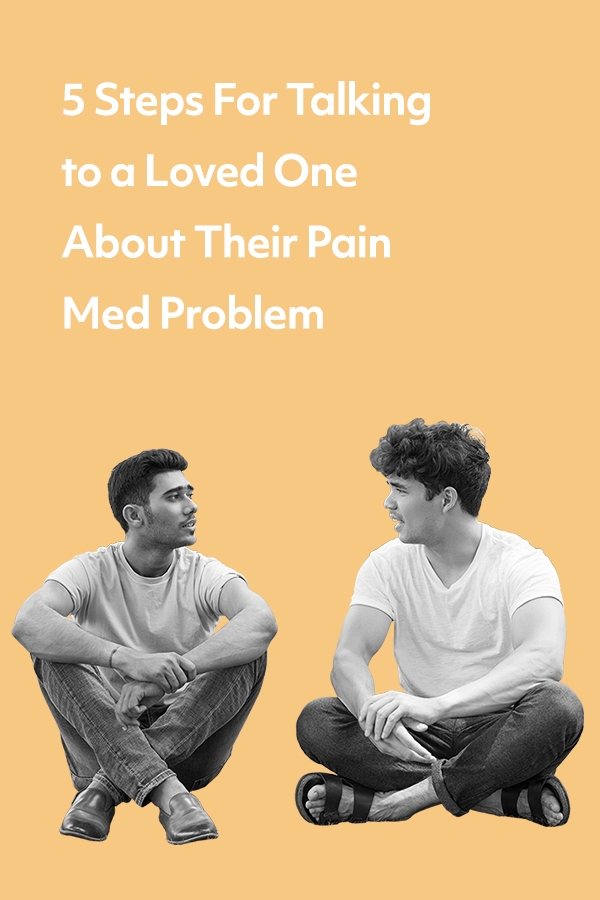

If you have a loved one who is struggling with pain meds, it can be hard to know how to talk to them about it. These steps can help.

Cassandra McIntosh is a Workit Health contributor. She brings a unique mix of expertise drawn from her background in counseling psychology, socio-organizational psychology and consumer insights.

PrevHospitality and Addiction Recovery
10 Books About Trauma and AddictionNext

Any general advice posted on our blog, website, or app is for informational purposes only and is not intended to replace or substitute for any medical or other advice. Workit Health, Inc. and its affiliated professional entities make no representations or warranties and expressly disclaim any and all liability concerning any treatment, action by, or effect on any person following the general information offered or provided within or through the blog, website, or app. If you have specific concerns or a situation arises in which you require medical advice, you should consult with an appropriately trained and qualified medical services provider.

Top

Get the latest recovery news

Instagram Linkedin-in Facebook-f Youtube
  • Treatments
  • Opioids
  • Alcohol: Core Program
  • Alcohol: Flex Program
  • About Workit Health
  • Contact us
  • Our team
  • Media spotlight
  • Careers
  • We Accept Insurance
  • Check insurance
  • Aetna
  • Anthem of Ohio
  • Horizon BCBSNJ
  • Humana
  • Resources
  • What is harm reduction?
  • Addiction recovery resources
  • Suboxone FAQs
  • Blog
  • Friends and Family
  • Resources for friends and family
  • Help Them Heal Guide
  • Members
  • Login
  • Community
  • Request medical records
  • Tech support guides
  • Call us: 855-659-7734 M-F 8am-9pm EST
    • Partners
    • Make a referral
    • For health plans
    • For providers and hospitals
    • Third-party medical records requests
Read more about Suboxone risks and concerns

Suboxone (buprenorphine/naloxone) is indicated for the treatment of opioid dependence in adults. Suboxone should not be taken by individuals who have been shown to be hypersensitive to buprenorphine or naloxone as serious adverse reactions, including anaphylactic shock, have been reported. Taking Suboxone (buprenorphine/naloxone) with other opioid medicines, benzodiazepines, alcohol, or other central nervous system depressants can cause breathing problems that can lead to coma and death. Other side effects may include headaches, nausea, vomiting, constipation, insomnia, pain, increased sweating, sleepiness, dizziness, coordination problems, physical dependence or abuse, and liver problems. For more information about Suboxone (buprenorphine/naloxone) see Suboxone.com, the full Prescribing Information, and Medication Guide, or talk to your healthcare provider. You are encouraged to report negative side effects of drugs to the FDA. Visit www.fda.gov/medwatch or call 1-800-FDA-1088.

All clinical and medical services are provided by licensed physicians and clinicians who are practicing as employees or contractors of independently owned and operated professional medical practices that are owned by licensed physicians. These medical practices include Workit Health (MI), PLLC; Workit Health (CA), P.C.; Workit Health (NJ), LLC; Workit Health (OH), LLC; Virtual Physician Practice (NY), PLLC; and any other Workit Health professional entity that is established in the future.

Clinic locations

Arizona
9700 N. 91st. St.
Ste A-115
Scottsdale, AZ 85258
fax (HIPAA): (833) 664-5441

California
1460 Maria Lane
Ste 300
Walnut Creek, CA 94596
fax (HIPAA): (855) 716-4494

Florida
600 Heritage Dr.
Ste 210, #17
Jupiter, FL 33458
fax (HIPAA): (813) 200-2822

Illinois
1280 Iroquois Ave
Ste 402
Naperville, IL 60563
fax (HIPAA): (855) 716-4494

Michigan
3300 Washtenaw Ave
Ste 280
Ann Arbor, MI 48104
fax (HIPAA): (855) 716-4494

Montana
415 N Higgins Ave
Ste 6
Missoula, MT 59802
fax (HIPAA): (855) 716-4494

New Jersey
5 Greentree Center
Ste 117
Marlton, NJ 08053
fax (HIPAA): (609) 855-5027

New Mexico
5901 Indian School Road, NE
Ste 212
Albuquerque, NM 87110
fax (HIPAA): (855) 716-4494

Ohio
6855 Spring Valley Dr
Ste 110
Holland, OH 43528
fax (HIPAA): (513) 823-3247

Oklahoma
1010 24th Ave NW
Suite 100
Norman, OK 73069
fax (HIPAA): (855) 716-4494

Texas
5373 W Alabama St
Ste 204
Houston, TX 77056
fax (HIPAA): (737) 738-5046

Washington
9116 Gravelly Lake Dr SW
Ste 107 #3, PMB 1963
Lakewood, WA 98499-3148.
fax (HIPAA): (833) 328-1407

AICPA SOC

Terms of Service

Privacy Policy

Notice of Privacy Practice

View Accessibility Statement

© 2025 Workit Health. All rights reserved.

Your recovery, your way—
100% online

Book your appointment
Check your insurance coverage
  • Aetna
  • Humana
  • Horizon
  • Cigna
  • Blue Cross Blue Shield
  • and more

👉 Using insurance? Coverage checks are always for free in the Workit Health app.

Check your coverage

Not ready to start? We'll send you more information:

  • *Messaging frequency varies. I can unsubscribe at any time.

    **Messaging frequency varies. Message and data rates may apply. I can opt out at any time by replying STOP. I can reply HELP to receive support. If I do not consent to receive SMS, and Workit Health is unable to reach me by email, I understand that they will not be able to contact me by text.

    View our Privacy Policy, Terms of Service, and Consent to SMS and Email.

  • Should be Empty:

This site uses cookies to improve your experience. By using this site, you consent to our use of cookies.

Accept Cookies