Skip to content

Marc Lee Shannon Live in Concert | Wed. Nov. 19th

  • Online Recovery
    • Quit Opioids
    • Suboxone
    • Insurance or self-pay
    • At-home drug screenings
    • Quit Kratom
    • Medication assistance
    • Insurance or self-pay
    • Whole-person care (anxiety, insomnia, etc.)
    • Quit Drinking
    • Campral
    • Naltrexone
    • Insurance or self-pay
    • 100% Online
    • Non-judgmental providers
    • Help with co-occurring disorders​
    • Recovery groups
    • Real people (No AI bots)
  • About Us
    • Our Research

    Advancing substance use treatment through rigorous, peer-reviewed research and actionable insights.

    • Our Mission

    Everyone deserves access to the gold standard of treatment, without judgment.

    • Growing Our Team

    Join us in transforming addiction treatment and improving lives through digital care.

    • Founded and operated by people in recovery since 2015
  • Resources
    • Workit Health
    • Insurance checker
    • Locations
    • Reviews
    • Articles
    • Member stories
    • Opioid addiction help
    • Suboxone Basics
    • Quit drinking
    • Naltrexone basics
    • For friends and family
    • Resources
    • Help a loved one with addiction
    • Mental health apps
    • Helplines and support
    • Community in recovery
    • Medication resources
    • 32k+ App store reviews
    • 35k+ Members
    • 33% Referred by friends or family
  • Partners
  • Make A Referral
Book now
Book now
Book now
Login
  • Quit Opioids
  • Suboxone
  • Insurance or self-pay
  • At home drug screenings
  • Quit Kratom
  • Medication assistance
  • Insurance or self-pay
  • Whole-person care (anxiety, insomnia,etc.)
  • Quit Drinking
  • Medication assistance
  • Insurance or self-pay
  • Recovery groups
  • 100% Online
  • Non-judgmental providers
  • 35k+ Members
  • 3.2k+ Reviews
About Us
  • Our Research
  • Our Mission
  • Growing Our Team
Resources
  • Workit Health
  • Insurance checker
  • Locations
  • Reviews
  • Articles
  • Member stories
  • Opioid addiction help
  • Suboxone Basics
  • Quit drinking
  • Naltrexone basics
  • For friends and family
  • Resources
  • Help a loved one with addiction
  • Mental health apps
  • Helplines and support
  • Community in recovery
  • Medication resources
  • Partners
  • Make A Referral
  • Culture, Stories Of Recovery
  • eating, parenting in recovery

There’s Nothing to Lose: Modeling the Rejection of Diet Culture for Teens

  • Fact Checked and Peer Reviewed
  • By Emily Green

A future free of addiction is in your hands

Recover from addiction at home with medication, community, and support—from the nonjudmental experts who really care.

Get started today

What's your goal?

Join the 35k+ members who treated addiction via their phone

In a dark space, a person wears a gleaming golden comedy mask and gestures widely with their arms.

Toxic Positivity vs. Healthy Optimism

Olivia Pennelle
A person's feet in brown hiking boots, standing in the snow.

Alone On Christmas: How To Cope If You Aren’t With Family Or Friends This Year

Kali Lux
New Mexico in the sunset

How to Find Drug Addiction Help in New Mexico

Alaine Sepulveda

In this article

After years of hoping my kids would “do what I say, not what I do,” I’m finally able to model healthy behaviors and attitudes.

For most of my adult life, everything revolved around my adherence to, or lack thereof, a diet or workout regimen. The orbit of my days rarely drifted, but when they did, I could pivot for the rare indulgence; I would later atone for a day of rest. Ultimately, this comfortable routine became a predictable mess, an unsustainable way to enjoy life and to set an example as a parent.

I found myself telling my children to do one thing regarding their body respect and another in modeling such. I might say to my children, “trust me and my judgment,” but show them I can’t even trust myself. I walked around our home, entering my meals into digital logs so that an app could calculate the direction of my nutrition day instead of listening to my own body. I routinely contradicted myself in their presence, coaching others on being strong, all the while chastising my own powerful body as something too weak to resist “forbidden” foods. As a running coach at their middle school, I shared the usual platitudes on loving oneself, encouraging preteen girls to appreciate what their bodies could achieve through sport. At the same time, at home, I would make phone calls within earshot of my son and daughter to lament the growing appetite brought on by the rigors of marathon training. I figured they wouldn’t be paying attention, but they were always listening. 

It was convenient to think that diet culture’s hold on me was an invisible grip. I was ignorant to believe that my disordered eating would somehow skip a generation, naive to assume my children would be spared dieting through the cultural rebranding of wellness. 

“It was convenient to think that diet culture’s hold on me was an invisible grip.”

So when it came time for my reckoning with diets, for me to take on the most demanding work of my life, I worried that it was too late for kids. I had watched them adapt to the many changes of our family before, but I knew I shouldn’t underestimate the dieting leviathan. It goes by many insidious names, supports lucrative businesses, and shapes public health. So how could I fight against a system that has many Americans willing to admit they would prefer death over being fat and come out on the other side flanked by my children unscathed? 

Although I couldn’t turn back time, I could rewind the discourse in my home. I began to say and do things that signaled the rejection of diet culture. Just as I had done countless times before when I wanted them to learn something, I said what I wanted them to do, showed them how to accomplish it, and then reinforced it. 

Hear Me 

I announced to both of my kids that I would never mention my weight again and that I would not be forming a menu around the restriction of any kind henceforth. I didn’t clear the cabinets; I added to them, listening to my anti-diet coach when she asked me to stock up on all my previously policed items. I explained that we would now have an abundance of the foods we had previously only gotten for special occasions, things like cookies, cakes, chips, and ice cream. Finally, I told the kids I would throw out my scale and stop getting weighed at the doctor. The announcements were all met with a rather unenthusiastic “okay,” and I didn’t care. I wanted them to remember my words for what would come next. 

Watch Me

A large part of dissimilation from diet culture is rewiring our thinking around morality and food. So, at the suggestion of my partner—to remind me that food was neither bad nor good, it just was—I posted notes in my cabinets, on my bathroom mirror, and other areas where diet culture might haunt me with the ghosts of doubt. My daughter remarked how strange this was, so I playfully left her a post-it affirmation on her desk the next day. It now hangs in her bathroom, something I choose to believe is in solidarity rather than in jest. Recently, I began to wear just a sports bra and running tights to train, leaving behind the shirts I used to cover what I thought was too much, not enough, and vulnerable to the outside. Each time I step out in ways that ask me to show up, I demonstrate that discomfort is part of the rebellion, that much like my choice to stop drinking, the resistance is the point. 

Lastly, the work I am doing isn’t just about the impacts on my children, but also on how I care for others as a whole. Diet culture requires us not to fear fat but hate it, vilifying fat people. I can reinforce anti-diet practices by addressing anti-fat bias within myself and the surrounding culture. In her book “What We Don’t Talk About When We Talk About Fat,” Aubrey Gordon explains that “anti-fat bias is a cultural force that simultaneously shapes and is expressed through our most commanding institutions; government, healthcare, education, and media. Anti-fatness isn’t just something each of us bears—it’s something we become.” In that vein, to admit that you see fat as the worst thing that could happen to you or to anyone else means you must reconcile with how you define health and humanity. It is a bitter and necessary pill to swallow if you genuinely want to reject diet culture and control. As a parent, I teach my children that discrimination in all forms is wrong, so how can I let this kind slide as something acceptable and, worse yet, morally superior? 

Follow Me 

The decision to challenge my relationship with diet culture, wellness, and what it means to be healthy has changed my life. I encourage anyone to learn more about this movement through the leadership of experts like Lindo Bacon, Aubrey Gordon, Roxanne Gay, Cara Harbstreet, Christy Harrison, Isabel Foxen Duke, and many more. These people have written books and blogs and provided classes, coaching, and more. 

However, implementing anti-diet practices doesn’t mean anything is more manageable; in fact, it’s just the opposite. I still struggle to resist dieting, feeling the walls cave in around me at the grocery store, in the mirror, and late at night. Even so, I can see the light at the end of the tunnel, the sustained practice of rejecting a part of a culture that seeks not just to shrink but to destroy me. I want my children to question forever what society tells them they should be, should do, or should call “good,” which begins with how I conduct my own life.

There is no better lesson to teach and for my children to learn.
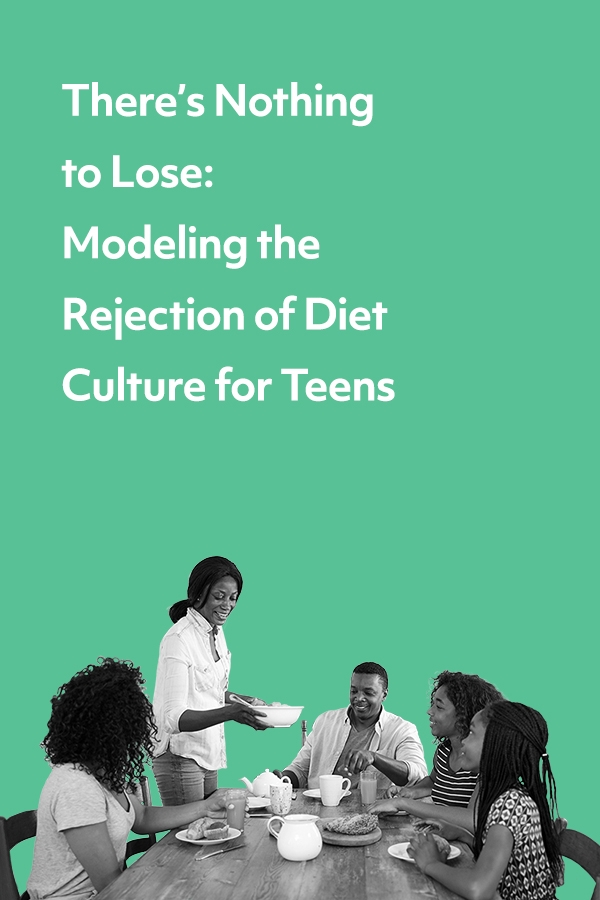
As parents, we often hope our kids will do what we say, not what we do. This firsthand account addresses how to model the rejection of diet culture so our kids can learn healthier atiitudes toward food and bodies.

Emily Green (she/her) is an educator, writer, and co-creator of The Outset. She combines movement and activism to inspire athletes who seek to liberate themselves from drinking culture. She’s working on a collection of essays, A Kaleidoscope of Discomfort, about grief, sobriety, sexuality, and running.

Twitter: @EmilyEmforshort
Instagram: @ehaswings

PrevNew Year = New Change? Not Usually
Home As The New Recovery ParadigmNext

Any general advice posted on our blog, website, or app is for informational purposes only and is not intended to replace or substitute for any medical or other advice. Workit Health, Inc. and its affiliated professional entities make no representations or warranties and expressly disclaim any and all liability concerning any treatment, action by, or effect on any person following the general information offered or provided within or through the blog, website, or app. If you have specific concerns or a situation arises in which you require medical advice, you should consult with an appropriately trained and qualified medical services provider.

Top

Get the latest recovery news

Instagram Linkedin-in Facebook-f Youtube
  • Treatments
  • Opioids
  • Alcohol: Core Program
  • Alcohol: Flex Program
  • About Workit Health
  • Contact us
  • Our team
  • Media spotlight
  • Careers
  • We Accept Insurance
  • Check insurance
  • Aetna
  • Anthem of Ohio
  • Horizon BCBSNJ
  • Humana
  • Resources
  • What is harm reduction?
  • Addiction recovery resources
  • Suboxone FAQs
  • Blog
  • Friends and Family
  • Resources for friends and family
  • Help Them Heal Guide
  • Members
  • Login
  • Community
  • Request medical records
  • Tech support guides
  • Call us: 855-659-7734 M-F 8am-9pm EST
    • Partners
    • Make a referral
    • For health plans
    • For providers and hospitals
    • Third-party medical records requests
Read more about Suboxone risks and concerns

Suboxone (buprenorphine/naloxone) is indicated for the treatment of opioid dependence in adults. Suboxone should not be taken by individuals who have been shown to be hypersensitive to buprenorphine or naloxone as serious adverse reactions, including anaphylactic shock, have been reported. Taking Suboxone (buprenorphine/naloxone) with other opioid medicines, benzodiazepines, alcohol, or other central nervous system depressants can cause breathing problems that can lead to coma and death. Other side effects may include headaches, nausea, vomiting, constipation, insomnia, pain, increased sweating, sleepiness, dizziness, coordination problems, physical dependence or abuse, and liver problems. For more information about Suboxone (buprenorphine/naloxone) see Suboxone.com, the full Prescribing Information, and Medication Guide, or talk to your healthcare provider. You are encouraged to report negative side effects of drugs to the FDA. Visit www.fda.gov/medwatch or call 1-800-FDA-1088.

All clinical and medical services are provided by licensed physicians and clinicians who are practicing as employees or contractors of independently owned and operated professional medical practices that are owned by licensed physicians. These medical practices include Workit Health (MI), PLLC; Workit Health (CA), P.C.; Workit Health (NJ), LLC; Workit Health (OH), LLC; Virtual Physician Practice (NY), PLLC; and any other Workit Health professional entity that is established in the future.

Clinic locations

Arizona
9700 N. 91st. St.
Ste A-115
Scottsdale, AZ 85258
fax (HIPAA): (833) 664-5441

California
1460 Maria Lane
Ste 300
Walnut Creek, CA 94596
fax (HIPAA): (855) 716-4494

Florida
600 Heritage Dr.
Ste 210, #17
Jupiter, FL 33458
fax (HIPAA): (813) 200-2822

Illinois
1280 Iroquois Ave
Ste 402
Naperville, IL 60563
fax (HIPAA): (855) 716-4494

Michigan
3300 Washtenaw Ave
Ste 280
Ann Arbor, MI 48104
fax (HIPAA): (855) 716-4494

Montana
415 N Higgins Ave
Ste 6
Missoula, MT 59802
fax (HIPAA): (855) 716-4494

New Jersey
5 Greentree Center
Ste 117
Marlton, NJ 08053
fax (HIPAA): (609) 855-5027

New Mexico
5901 Indian School Road, NE
Ste 212
Albuquerque, NM 87110
fax (HIPAA): (855) 716-4494

Ohio
6855 Spring Valley Dr
Ste 110
Holland, OH 43528
fax (HIPAA): (513) 823-3247

Oklahoma
1010 24th Ave NW
Suite 100
Norman, OK 73069
fax (HIPAA): (855) 716-4494

Texas
5373 W Alabama St
Ste 204
Houston, TX 77056
fax (HIPAA): (737) 738-5046

Washington
9116 Gravelly Lake Dr SW
Ste 107 #3, PMB 1963
Lakewood, WA 98499-3148.
fax (HIPAA): (833) 328-1407

AICPA SOC

Terms of Service

Privacy Policy

Notice of Privacy Practice

View Accessibility Statement

© 2025 Workit Health. All rights reserved.

Your recovery, your way—
100% online

Book your appointment
Check your insurance coverage
  • Aetna
  • Humana
  • Horizon
  • Cigna
  • Blue Cross Blue Shield
  • and more

👉 Using insurance? Coverage checks are always for free in the Workit Health app.

Check your coverage

Not ready to start? We'll send you more information:

  • *Messaging frequency varies. I can unsubscribe at any time.

    **Messaging frequency varies. Message and data rates may apply. I can opt out at any time by replying STOP. I can reply HELP to receive support. If I do not consent to receive SMS, and Workit Health is unable to reach me by email, I understand that they will not be able to contact me by text.

    View our Privacy Policy, Terms of Service, and Consent to SMS and Email.

  • Should be Empty:

This site uses cookies to improve your experience. By using this site, you consent to our use of cookies.

Accept Cookies