Skip to content

Workit Health Presents: A Dopey Interview of Amy Dresner · Live on YouTube · June 10, 2026 · 7pm est

  • Treatments
    • Opioid Use Disorder

    Start Suboxone treatment online with a licensed provider without judgment.

    • Alcohol Use Disorder

    Flexible goals — moderation or abstinence. Evidence-based, no 12-step requirement

    • Kratom & 7-OH

    Medication options that actually work for withdrawals and cravings.

    Anxiety · Depression · Insomnia · Hepatitis C · And more

    Substance use often goes hand-in-hand with other conditions. Your provider can prescribe for many of these, including anxiety, depression, and insomnia—so you can get back on solid ground. They can even treat hepatitis C and prescribe PrEP for HIV prevention.

    Start treatment
  • Pricing
  • Locations

    Available now

    • Arizona
    • California
    • Florida
    • Illinois
    • Michigan
    • Montana
    • New Jersey
    • New Mexico
    • New York
    • North Carolina
    • Ohio
    • Oklahoma
    • Texas
    • Washington
    Get notified if we open in your state
  • Reviews
  • About
    • About Workit Health

    Our mission, founders, and clinical team.

    • Workit Labs · Research

     Peer-reviewed publications on telehealth addiction care.

    • Blog

    Plain language guides on recovery, medication, and family-support.

    • Careers

    Join the team building the future of addiction care

    • Please reach out—we’re here to help:
    • Hello@WorkitHealth.com
    • 855-659-7734
  • Help Someone
Login
Get started
Get started
  • Login to my account
Treatments
  • Opioid use disorder
  • Suboxone
  • Alcohol use disorder
  • Kratom & 7-OH dependency

whole person care included

Substance use often goes hand-in-hand with other conditions. Your provider can prescribe for many of these, including anxiety, depression, insomnia, hepatitis C, and more—so you can get back on solid ground.

  • Insurance or Self-pay
Locations
  • Arizona
  • California
  • Florida
  • Illinois
  • Michigan
  • Montana
  • New Jersey
  • New Mexico
  • New York
  • North Carolina
  • Ohio
  • Oklahoma
  • Texas
  • Washington
  • Get notified of new state openings →
  • Reviews
About
  • About Workit Health
  • Workit Labs · Research
  • Blog
  • Careers
  • Hello@WorkitHealth.com
  • 855-659-7734
  • Refer a friend
  • Help Someone
Get started

In crisis? Call or text: 988

Home > Blog > Deciding to Get Help: Stages of Change

  • Culture, For Friends And Family

Deciding to Get Help: Stages of Change

Addiction recovery is a process of change and often happens a little at a time, like in this six-stage model of behavior change.

BY

  • Alaine Sepulveda
  • Fact-checked & medically reviewed

on this page

It’s common to want recovery to happen all at once, right now. But while that desire is natural, it’s not a very realistic expectation. Recovery is a process of change, and change often happens a little at a time. 

Researchers believe that people cycle through a six-stage process of change in our journey to overcome addiction. The fancy, academic name for it is the “transtheoretical model of behavior change.” In the abstract, the process looks like this:

  1. Pre-contemplation 
  2. Contemplation 
  3. Preparation 
  4. Action 
  5. Maintenance 
  6. Relapse 

I say, “in the abstract,” because in real life our process might not go in order from stage 1 to stage 6. For example, a person might jump from contemplation straight into action, then maintenance. Or they might shift back and forth between contemplation and preparation for a long time before moving into action. Some researchers describe this process as a spiral rather than a cycle in recognition of the fact that, for many people, relapse can be part of the process as they move toward long-term recovery.
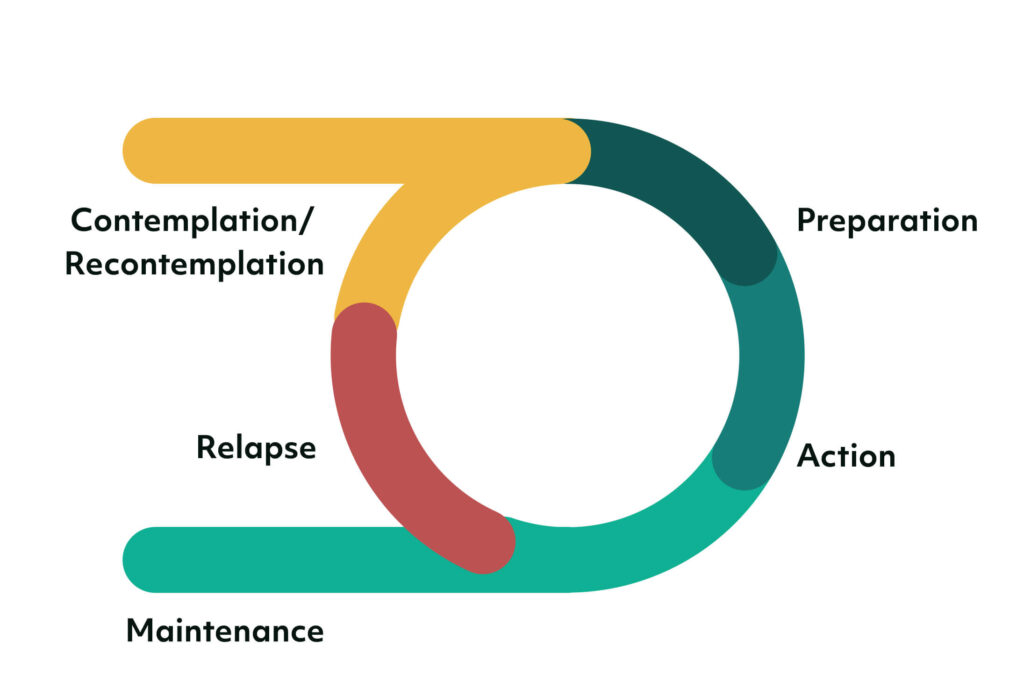
A graphic illustrating the stages of change.

Pre-contemplation

Have you heard the phrase, “The first step is admitting that you have a problem”? That’s not actually the case. There is a stage that comes before making that admission: becoming aware that a problem with drugs or alcohol exists at all. For example, I spent quite a while convinced that alcohol was the answer to my problems, rather than a major source of them. A lot of us also devote a great deal of energy to denial, refusing to face the consequences of our actions. Some people never move out of this stage—staying in denial over their problem with drugs or alcohol even as their substance use ruins their relationships, health, and well-being. But those of us who do realize that we have a problem can move forward beyond pre-contemplation into another stage. 

Contemplation

When a person reaches the contemplation stage, they may be willing to face their use of substances and may even try to moderate and stop. They are willing to learn more about their addictive behavior. However, at this stage they may not yet want to change long-term, or be ready to commit to a treatment program. A person in the contemplation stage may stay in it for days, months, or even years. They may move back to the pre-contemplation stage, or forward to the preparatory stage.

If you have a loved one who seems to be in this stage of change, it can be most helpful when they receive nonjudgmental support and encouragement. Pressure to hurry up and be ready for recovery may result in the person moving back to the pre-contemplation stage.  

Preparation

The preparation stage occurs right before the person is ready to take action about their substance use. This is the stage where many of us start taking a lot of online quizzes like, “Are you an alcoholic?” or “Is your drug use becoming a problem?” In this stage, a person might be researching treatment options and trying to figure out how they can get help when they’re ready.  They may also start removing triggers from their home, or getting rid of their supply of drugs or alcohol.

If you have a loved one who seems to be in the preparation stage, you can help them look into treatment programs, research cost and insurance coverage, or help them find meetings nearby. You can’t make them be ready, but you can assist them in finding resources.

Action 

The action stage is the part we tend to talk about the most. It represents changes in behavior. A person might stop using substances on their own (although a lot of folks who would like to take this route discover that it doesn’t work for them), go to a treatment center, start medication-assisted treatment, attend a mutual-aid meeting (like a 12-step or other recovery program), get honest with a counselor, or check into a medical detox. For some people, the action stage is made of small, positive steps forward, while for others, it is a sudden and major revolution. 

If you have a loved one in the action stage, try to support the positive steps they’re taking. This could include helping them remember to take their meds, get to an appointment, or attend a meeting. It’s also important to remember NOT to punish the actions they’re taking by criticizing or judging them for not getting to this stage sooner.

Maintenance

This stage is focused on maintaining the positive behavioral changes. That might mean moving from detox to a treatment center or sober living. Or it could mean creating a routine of recovery supports like meetings, doctor appointments, or therapy. Different people have different recovery goals and needs, so their maintenance stage may not look like everyone else’s. For some folks this stage means taking medication. It can mean abstaining completely or it can mean harm reduction. 

Many of the recovery activities we take in the maintenance phase are geared around helping us develop effective and healthy coping skills. This is vital, as most of us previously used substances as a stand-in for coping. Building new skills and strategies helps us avoid relapse.  

Relapse

While many of us are able to avoid relapse, it is a common part of the process of recovery. Not everyone who stops will remain stopped. But relapse doesn’t necessarily mean a person is leaving the spiral; a lot of folks who relapse (even more than once) go on to establish long-term recovery. 

We have several posts about relapse and getting back on track afterward. 

I find this framework helpful for understanding the process of making a decision about getting help and getting into recovery. I hope you do, too. Just remember that in real life, it tends to look a little messier and less ordered than it does when we list out the stages.

PrevpreviousGetting Through the First Few Weekends Sober
nextLibrium for Alcohol WithdrawalNext

on this page

need help?

Stop the cycle of cravings and withdrawal

  • Suboxone prescribed online*
  • Most major insurance accepted
  • $25–$35/mo with insurance
  • ~2 days to first appointment

*as clinically appropriate

Download the app →

Learn about treatment

PrevpreviousGetting Through the First Few Weekends Sober
nextLibrium for Alcohol WithdrawalNext

ABOUT THE AUTHOR

Alaine Sepulveda is a content strategist in recovery from alcohol. She believes that engaging people and sharing stories with them allows us to spread knowledge, and to help others in the path to recovery. She holds an MA in Communication Studies from New Mexico State University.

ready when you are​

Download the app. Get back to yourself.

Sign up takes about 5 minutes. Most members have their first appointment within 2 days. Covered by most insurance.

Download the app
Learn more

KEEP READING

Why Is Suboxone Taken Sublingually?

Many medications are swallowed, but Suboxone (buprenorphine/naloxone) is taken under the tongue (sublingually) or on the cheek (buccally).

Read now

True or False: “Less Is More” When Taking Suboxone

Why do some people say a lower dose of Suboxone will work better? Is less more? Nurse practitioner Dana Forman explains the thinking behind this common myth.

Read now

5 Questions About Online Suboxone Treatment, Answered

Workit Health treats opioid addiction with medication like Suboxone online via telehealth. How do we do it? In this post, we answer several common questions.

Read now

Any general advice posted on our blog, website, or app is for informational purposes only and is not intended to replace or substitute for any medical or other advice. Workit Health, Inc. and its affiliated professional entities make no representations or warranties and expressly disclaim any and all liability concerning any treatment, action by, or effect on any person following the general information offered or provided within or through the blog, website, or app. If you have specific concerns or a situation arises in which you require medical advice, you should consult with an appropriately trained and qualified medical services provider.

A future free of addiction is in your hands

Recover from addiction at home with medication, community, and support—from the nonjudmental experts who really care.

Get started today

100% virtual addiction treatment for opioid, alcohol, and kratom use disorders. Evidence-based medication, therapy, and recovery support—from your phone.

Please reach out—we’re here to help:
hello@workithealth.com
855-659-7734

Instagram Linkedin-in Facebook-f Youtube
    • TREATMENTS
    • Opioids
    • Kratom & 7-OH
    • Alcohol
    • Insurance & Cost
    • Locations
    • Get started
    • HELP SOMEONE
    • Help a loved one
    • Refer a friend
    • Recovery blog
    • Narcan guide
    • COMPANY
    • About
    • Workit Labs · Research
    • Careers
    • Partnerships
      • MEMBERS
      • Login
      • Create account
      • Refer a friend
      • Medical records request form
      • Fax: 833-923-0584
AICPA SOC
  • 42 CFR Part 2
  • WCAG 2.1 AA

contact information

Arizona
2501 N Hayden Rd.
Ste 103
Scottsdale, AZ 85257
fax (HIPAA): (833) 664-5441

California
1460 Maria Lane
Ste 300
Walnut Creek, CA 94596
fax (HIPAA): (833) 244-6705

Florida
600 Heritage Dr.
Ste 210, #17
Jupiter, FL 33458
fax (HIPAA): (813) 200-2822

Illinois
1280 Iroquois Ave
Ste 402
Naperville, IL 60563
fax (HIPAA): (833) 664-8715

Michigan
3300 Washtenaw Ave
Ste 280
Ann Arbor, MI 48104
fax (HIPAA): (855) 716-4494

Montana
415 N Higgins Ave
Ste 6
Missoula, MT 59802
fax (HIPAA): (833) 664-5486

New Jersey
5 Greentree Center
Ste 117
Marlton, NJ 08053
fax (HIPAA): (609) 855-5027

New Mexico
5901 Indian School Road, NE
Ste 212
Albuquerque, NM 87110
fax (HIPAA): (833) 664-5701

New York
845 Central Avenue
Ste 204
Albany, NY 12206
fax (HIPAA): (844) 921-1079

North Carolina
3719 Latrobe Drive
Ste 850-M
Charlotte, NC 28211-4827
fax (HIPAA): (984) 375-6710

Ohio
6855 Spring Valley Dr
Ste 110
Holland, OH 43528
fax (HIPAA): (513) 823-3247

Oklahoma
1010 24th Ave NW
Suite 100
Norman, OK 73069
fax (HIPAA): (833) 672-3125

Texas
5373 W Alabama St
Ste 204
Houston, TX 77056
fax (HIPAA): (737) 738-5046

Washington
9116 Gravelly Lake Dr SW
Ste 107 #3, PMB 1963
Lakewood, WA 98499-3148.
fax (HIPAA): (833) 328-1407

suboxone risk & concerns

Suboxone (buprenorphine/naloxone) is indicated for the treatment of opioid dependence in adults. Suboxone should not be taken by individuals who have been shown to be hypersensitive to buprenorphine or naloxone as serious adverse reactions, including anaphylactic shock, have been reported. Taking Suboxone (buprenorphine/naloxone) with other opioid medicines, benzodiazepines, alcohol, or other central nervous system depressants can cause breathing problems that can lead to coma and death. Other side effects may include headaches, nausea, vomiting, constipation, insomnia, pain, increased sweating, sleepiness, dizziness, coordination problems, physical dependence or abuse, and liver problems. For more information about Suboxone (buprenorphine/naloxone) see Suboxone.com, the full Prescribing Information, and Medication Guide, or talk to your healthcare provider. You are encouraged to report negative side effects of drugs to the FDA. Visit www.fda.gov/medwatch or call 1-800-FDA-1088.

© 2026 Workit Health. All rights reserved.
Privacy Policy

Notice of Privacy Practice

Terms of Service

View Accessibility Statement

All clinical and medical services are provided by licensed physicians and clinicians who are practicing as employees or contractors of independently owned and operated professional medical practices that are owned by licensed physicians. These medical practices include Workit Health (MI), PLLC; Workit Health (CA), P.C.; Workit Health (NJ), LLC; Workit Health (OH), LLC; Virtual Physician Practice (NY), PLLC; and any other Workit Health professional entity that is established in the future.

Not ready to start? We'll send you more information:

  • Workit Health

    When I opt in, Workit Health will send information about their program and recovery resources.

    *I agree to receive marketing and member care messages by email. Messaging frequency varies. I can unsubscribe at any time.

    **I agree to receive marketing and member care messages by text (SMS). Messaging frequency varies. Message and data rates may apply. I can opt out at any time by replying STOP. I can reply HELP to receive support. If I do not consent to receive SMS, and Workit Health is unable to reach me by email, I understand that they will not be able to contact me by text.

    Carriers are not liable for delayed or undelivered messages.

    View our Privacy Policy, Terms of Service, and Consent to SMS and Email.

  • Should be Empty:

This site uses cookies to improve your experience. By using this site, you consent to our use of cookies.

Accept Cookies