Skip to content

Workit Health Presents: A Dopey Interview of Amy Dresner · Live on YouTube · June 10, 2026 · 7pm est

  • Treatments
    • Opioid Use Disorder

    Start Suboxone treatment online with a licensed provider without judgment.

    • Alcohol Use Disorder

    Flexible goals — moderation or abstinence. Evidence-based, no 12-step requirement

    • Kratom & 7-OH

    Medication options that actually work for withdrawals and cravings.

    Anxiety · Depression · Insomnia · Hepatitis C · And more

    Substance use often goes hand-in-hand with other conditions. Your provider can prescribe for many of these, including anxiety, depression, and insomnia—so you can get back on solid ground. They can even treat hepatitis C and prescribe PrEP for HIV prevention.

    Start treatment
  • Pricing
  • Locations

    Available now

    • Arizona
    • California
    • Florida
    • Illinois
    • Michigan
    • Montana
    • New Jersey
    • New Mexico
    • New York
    • North Carolina
    • Ohio
    • Oklahoma
    • Texas
    • Washington
    Get notified if we open in your state
  • Reviews
  • About
    • About Workit Health

    Our mission, founders, and clinical team.

    • Workit Labs · Research

     Peer-reviewed publications on telehealth addiction care.

    • Blog

    Plain language guides on recovery, medication, and family-support.

    • Careers

    Join the team building the future of addiction care

  • Help Someone
Login
Get started
Get started
  • Login to my account
Treatments
  • Opioid use disorder
  • Suboxone
  • Alcohol use disorder
  • Kratom & 7-OH dependency

whole person care included

Substance use often goes hand-in-hand with other conditions. Your provider can prescribe for many of these, including anxiety, depression, insomnia, hepatitis C, and more—so you can get back on solid ground.

  • Insurance or Self-pay
Locations
  • Arizona
  • California
  • Florida
  • Illinois
  • Michigan
  • Montana
  • New Jersey
  • New Mexico
  • New York
  • North Carolina
  • Ohio
  • Oklahoma
  • Texas
  • Washington
  • Get notified of new state openings →
  • Reviews
About
  • About Workit Health
  • Workit Labs · Research
  • Blog
  • Careers
  • Refer a friend
  • Help Someone
Get started

In crisis? Call or text: 988

Home > Blog > Reducing Drug Addiction Stigma Through Language

  • Culture

Reducing Drug Addiction Stigma Through Language

But the fight to de-stigmatize drug use and addiction is far from over. Change also begins in the hearts and minds of regular people. One way to help bring that about comes in the fairly simple format of changing the way we talk about addiction.

BY

  • Elizabeth Brico
  • Fact-checked & medically reviewed

on this page

The words we use shape the way we define ourselves and the world around us.

In many ways, the landscape of 21st-century opioid addiction treatment is quite different than it was in the past. We have medication options that help practitioners recognize “detox” is not only unnecessary but often dangerous. The harm reduction movement—which values safety over forced abstinence—is steadily gaining traction across the nation. People with substance use disorders are able to look in the mirror and see the face of a person with a medical condition, instead of the image of “lowlife junkie” that our cultural consciousness has affixed to opioid use—especially IV opioid use—for so long.

But the fight to de-stigmatize drug use and addiction is far from over. Drugs are still heavily criminalized across the United States. People continue to face harsh, forced detoxification in jails, and some are even dying from highly preventable withdrawal complications, like dehydration. Drug court systems and child services agencies continue to prize coerced treatment over compassionate care. Many hospital staff still look down on mothers who give birth while on prescribed methadone or buprenorphine. These are just a few examples of the challenges still faced by those of us who live with opioid use disorders and/or advocate on behalf of those who do. And while a great many of these challenges require systemic, policy-based changes, change also begins in the hearts and minds of regular people. One way to help bring that about comes in the fairly simple format of changing the way we talk about addiction.

Medication-Assisted Treatment vs Pharmacotherapy

I was privileged enough to recently receive a travel scholarship from Northeastern University so that I could attend a meeting in Boston with a group of writers, advocates, doctors, legal professionals, policymakers, and harm reductionists where we discussed the way the dominant narrative of drug use and addiction shapes the very real treatment of people who use drugs or have substance use disorders. One of the terms that was brought up for reform was “medication-assisted treatment.”

“Change begins in the hearts and minds of regular people. One way to help bring that about comes in the fairly simple format of changing the way we talk about addiction.”

I was surprised to hear medication-assisted treatment (MAT) mentioned as a potentially stigmatizing term. It’s one that is used so often and by so many people, including evidence-based providers, that it never crossed my radar. I’m still not sure whether I’d place it in the same category as terms like “addict,” but the argument is definitely worth consideration.

The general argument, which was put forth at this meeting by Dr. Sarah Wakeman from Massachusetts General Hospital, was that including the word “assisted” promotes an understanding of medications like methadone or buprenorphine as partial treatments for opioid use disorder. Although many people who misuse opioids have co-occurring trauma or mental illness, and can greatly benefit from counseling or other psycho-social interventions, the fact is that methadone and buprenorphine have been shown to reduce opioid-related mortality and complications by 50% or more. They are, inherently, treatments for opioid addiction. Terms like “pharmacotherapy” or “medication treatment” encourage an understanding of these medicines as primary treatment models—which can be enhanced by incorporating other types of treatment, but do not require those other treatments in order to be successful.
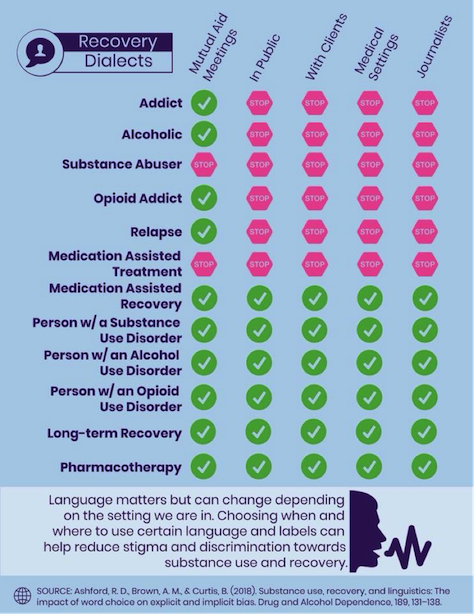
 Language guide via The Fix . Language guide via The Fix .

Substance Abuse

“Substance abuse” is a term that is considered outdated, but is still commonly used. There is no longer such a term as “substance abuse disorder;” it was updated in the DSM-V to “substance use disorder.” This is part of a movement away from the criminalization of addiction and toward a public health approach. The word “abuse” is associated with harmful, criminal activities. It has an inherently negative association. One which, as a survivor of physical and sexual abuse, is embedded in my addiction. I began using opiates as a means to self-medication post-traumatic stress disorder that resulted from being abused. This linguistic coupling of the actions that caused my trauma with the actions I took to self-medicate it creates a subtle but harmful association in my mind, and likely in the minds of other abuse survivors. Taking drugs does not put me on the same level as my abuser.

“This linguistic coupling of the actions that caused my trauma and the actions I took to self-medicate it creates a subtle but harmful association in my mind, and likely in the minds of other abuse survivors.”

Several recent studies found that the term “substance abuser” created negative associations toward people who engaged in drug misuse. Although drug use and addiction stigma are strong regardless of terminology, it was increased when people were referred to as “substance abusers.”  These findings matter, especially when they relate to a term that is still widely used in clinical practice. Addiction treatment is already rife with stigma. It will be until we end the war on drugs, which creates criminals out of drug users. But that stigma needs to be eliminated in clinical practice. Patients who feel judged and coerced by our treatment providers are more likely to relapse or outright drop out of treatment. Unfortunately, many clinicians still use the terms “substance abuse,” and “substance abuser,” and engage with patients through the same filter of unconscious bias that these terms promote.

Clean/Dirty

“Clean” and “dirty” are so commonly used to describe the state of abstinence-based sobriety or relapse that many people use them without question. I know I did. If I used and needed to provide a urine sample, that sample was dirty. If I didn’t use, my sample—and self—were “clean.” These words are taken for granted, but when you pause to think about them for a moment, the problem should be obvious: they imply that a person who has used a substance is dirty. This feeds right into the “dirty junkie” or “dirty addict” stereotypes that dehumanize drug users. So, every time we use the words “clean” and “dirty” to describe our state of sobriety—even if we are proudly proclaiming ourselves “clean”—we are promoting a view of drug users as dirty. We are also valuing our own self-worth with the chemicals we do or don’t ingest. And that’s wrong. You are just as worthy of respect and fulfillment high as you are sober.

Another issue with this terminology is that it prioritizes abstinence-based recovery. The way people respond to addiction is inherently individual. As Loretta Finnegan, a renowned addiction-treatment physician and the Executive Officer for the College on Problems of Drug Dependence recently told me during an interview for an article I wrote for The Fix, “In most diseases, there are many ways to treat them.” The same should absolutely be true about addiction. That means that while total abstinence works great for some people, moderating usage works better for others, while cannabis-based therapy works wonders for others. There should be myriad addiction treatment options, and one should not be generally valued above the others. The people who use marijuana or moderate their consumption are no more “dirty” than people who use no drugs at all.

Humans are a storytelling species. The words we use shape the way we define ourselves and the world around us. Small changes in language won’t end the drug war, but they can help shift the dominant narrative about drug use and addiction into one that promotes evidence-based care, medicinal versus law enforcement approaches, and an understanding of the people affected as exactly that: people.

PrevpreviousHow To Find The Best Suboxone Doctor In Michigan
nextWhy Michael Venn Created His Documentary the “The Heroin Effect”Next

on this page

need help?

Stop the cycle of cravings and withdrawal

  • Suboxone prescribed online*
  • Most major insurance accepted
  • $25–$35/mo with insurance
  • ~2 days to first appointment

*as clinically appropriate

Download the app →

Learn about treatment

PrevpreviousHow To Find The Best Suboxone Doctor In Michigan
nextWhy Michael Venn Created His Documentary the “The Heroin Effect”Next

ABOUT THE AUTHOR

Elizabeth Brico is a freelance writer with an MFA in Writing & Poetics from Naropa University. She is a journalism fellow with TalkPoverty and a recipient of the 2021/22 Unicorn Fund. She is also a regular contributing writer for HealthyPlace’s trauma blog. Her work has appeared on Vice, Vox, Stat News, The Fix, and others. When she isn’t working, she can usually be found reading, writing, or watching speculative fiction.

ready when you are​

Download the app. Get back to yourself.

Sign up takes about 5 minutes. Most members have their first appointment within 2 days. Covered by most insurance.

Download the app
Learn more

KEEP READING

Why Is Suboxone Taken Sublingually?

Many medications are swallowed, but Suboxone (buprenorphine/naloxone) is taken under the tongue (sublingually) or on the cheek (buccally).

Read now

5 Questions About Online Suboxone Treatment, Answered

Workit Health treats opioid addiction with medication like Suboxone online via telehealth. How do we do it? In this post, we answer several common questions.

Read now

5 Sneaky Alcohol Myths and the Truth Behind Them

If you’ve drink at all, you’ve likely heard rumors and myths about alcohol and hangovers. Let’s go beyond the myths to face facts.

Read now

Any general advice posted on our blog, website, or app is for informational purposes only and is not intended to replace or substitute for any medical or other advice. Workit Health, Inc. and its affiliated professional entities make no representations or warranties and expressly disclaim any and all liability concerning any treatment, action by, or effect on any person following the general information offered or provided within or through the blog, website, or app. If you have specific concerns or a situation arises in which you require medical advice, you should consult with an appropriately trained and qualified medical services provider.

100% virtual addiction treatment for opioid, alcohol, and kratom use disorders. Evidence-based medication, therapy, and recovery support—from your phone.

hello@workithealth.com

Instagram Linkedin-in Facebook-f Youtube
    • TREATMENTS
    • Opioids
    • Kratom & 7-OH
    • Alcohol
    • Insurance & Cost
    • Locations
    • Get started
    • HELP SOMEONE
    • Help a loved one
    • Refer a friend
    • Recovery blog
    • Narcan guide
    • COMPANY
    • About
    • Workit Labs · Research
    • Careers
    • Partnerships
    • Contact
    • MEMBERS
    • Login
    • Create account
    • Refer a friend
    • Medical records request form
    • Fax: 833-923-0584
    • Phone: 855-659-7734
AICPA SOC
  • 42 CFR Part 2
  • WCAG 2.1 AA

contact information

Arizona
2501 N Hayden Rd.
Ste 103
Scottsdale, AZ 85257
fax (HIPAA): (833) 664-5441

California
1460 Maria Lane
Ste 300
Walnut Creek, CA 94596
fax (HIPAA): (833) 244-6705

Florida
600 Heritage Dr.
Ste 210, #17
Jupiter, FL 33458
fax (HIPAA): (813) 200-2822

Illinois
1280 Iroquois Ave
Ste 402
Naperville, IL 60563
fax (HIPAA): (833) 664-8715

Michigan
3300 Washtenaw Ave
Ste 280
Ann Arbor, MI 48104
fax (HIPAA): (855) 716-4494

Montana
415 N Higgins Ave
Ste 6
Missoula, MT 59802
fax (HIPAA): (833) 664-5486

New Jersey
5 Greentree Center
Ste 117
Marlton, NJ 08053
fax (HIPAA): (609) 855-5027

New Mexico
5901 Indian School Road, NE
Ste 212
Albuquerque, NM 87110
fax (HIPAA): (833) 664-5701

New York
845 Central Avenue
Ste 204
Albany, NY 12206
fax (HIPAA): (844) 921-1079

North Carolina
3719 Latrobe Drive
Ste 850-M
Charlotte, NC 28211-4827
fax (HIPAA): (984) 375-6710

Ohio
6855 Spring Valley Dr
Ste 110
Holland, OH 43528
fax (HIPAA): (513) 823-3247

Oklahoma
1010 24th Ave NW
Suite 100
Norman, OK 73069
fax (HIPAA): (833) 672-3125

Texas
5373 W Alabama St
Ste 204
Houston, TX 77056
fax (HIPAA): (737) 738-5046

Washington
9116 Gravelly Lake Dr SW
Ste 107 #3, PMB 1963
Lakewood, WA 98499-3148.
fax (HIPAA): (833) 328-1407

suboxone risk & concerns

Suboxone (buprenorphine/naloxone) is indicated for the treatment of opioid dependence in adults. Suboxone should not be taken by individuals who have been shown to be hypersensitive to buprenorphine or naloxone as serious adverse reactions, including anaphylactic shock, have been reported. Taking Suboxone (buprenorphine/naloxone) with other opioid medicines, benzodiazepines, alcohol, or other central nervous system depressants can cause breathing problems that can lead to coma and death. Other side effects may include headaches, nausea, vomiting, constipation, insomnia, pain, increased sweating, sleepiness, dizziness, coordination problems, physical dependence or abuse, and liver problems. For more information about Suboxone (buprenorphine/naloxone) see Suboxone.com, the full Prescribing Information, and Medication Guide, or talk to your healthcare provider. You are encouraged to report negative side effects of drugs to the FDA. Visit www.fda.gov/medwatch or call 1-800-FDA-1088.

© 2026 Workit Health. All rights reserved.
Privacy Policy

Notice of Privacy Practice

Terms of Service

View Accessibility Statement

All clinical and medical services are provided by licensed physicians and clinicians who are practicing as employees or contractors of independently owned and operated professional medical practices that are owned by licensed physicians. These medical practices include Workit Health (MI), PLLC; Workit Health (CA), P.C.; Workit Health (NJ), LLC; Workit Health (OH), LLC; Virtual Physician Practice (NY), PLLC; and any other Workit Health professional entity that is established in the future.

Not ready to start? We'll send you more information:

  • Workit Health

    When I opt in, Workit Health will send information about their program and recovery resources.

    *I agree to receive marketing and member care messages by email. Messaging frequency varies. I can unsubscribe at any time.

    **I agree to receive marketing and member care messages by text (SMS). Messaging frequency varies. Message and data rates may apply. I can opt out at any time by replying STOP. I can reply HELP to receive support. If I do not consent to receive SMS, and Workit Health is unable to reach me by email, I understand that they will not be able to contact me by text.

    Carriers are not liable for delayed or undelivered messages.

    View our Privacy Policy, Terms of Service, and Consent to SMS and Email.

  • Should be Empty:

This site uses cookies to improve your experience. By using this site, you consent to our use of cookies.

Accept Cookies