My mother came home from treatment and tried to take the house back. She walked in with rules and authority, and her first fight was with her father.
I heard all of it.
The conversation I wasn’t supposed to hear
My grandfather was babysitting me. When my mother came to pick me up, he asked what we were doing that night.
“I’m taking him to an AA meeting,” she said.
“Freddie,” he said, “go in the other room. The adults need to talk.”
I went, but I was a kid, and kids are curious. I turned a corner and kept listening.
“He’s not going to a meeting,” my grandfather said. “Let him be a kid. He doesn’t need to know about all those things.”
“No,” my mother said. “Why are we hiding this? If I had cancer, if I had kidney disease, if I had any medical illness, we would tell him. Growing up, we hid too much. I’m going to break that cycle with Freddie. He’s going to understand exactly who his parent is.”
“We can take him to church,” my grandfather said. “He’ll be in activities. That’s enough.”
“No,” my mother said. “We’re not having it.”
She won. I was nervous, because in my family nobody challenged an elder. We kept hard things quiet. I was watching a family cycle break. My mother, a social worker who had studied sociology, knew that silence gets handed down. Because I watched her, challenging elders never felt foreign to me.
Medicine agrees with her. In their article, Changing the Language of Addiction, Michael Botticelli and Howard Koh opened with, “Words matter.” They called addiction a chronic brain disorder and wrote that people can be effectively treated and enter recovery.
But that room is also where connection first broke. Before my mother could connect with me, she had to connect with the man helping raise me. They never did. They fought over one meeting and never built a shared way to raise a child around recovery.
You cannot connect with a child when the adults haven’t connected with each other first. John Bowlby, who founded attachment theory, called a caregiver a child’s secure base. Rules alone cannot be one. At that time, the connection and the secure base were missing from my mother’s relationship with me.
The cost of surviving
James Baldwin wrote: “Anyone who has ever struggled with poverty knows how extremely expensive it is to be poor.” My mother knew. She was a Black, single woman and a social worker in recovery, living with severe mental illness. The World Health Organization says the conditions people are born, grow, live, work, and age in shape health, and warns that “social injustice is killing people on a grand scale.” Economists report that unmarried Black women typically fare worst in wealth. Arline Geronimus calls the toll of such hardship on the body “weathering.”
The sports and programs cost money my mother had already stretched thin. AA, Alateen, and therapy didn’t cost money, but all cost time she didn’t have. She thought activities were connection. She didn’t know connection was its own act, and the world never gave her space to learn.
Why did my grandfather want to hide my mother’s addiction and recovery? I believe it was love, and a family shielding itself from judgment. Sociologist Patricia Hill Collins calls stereotypes of Black women “controlling images” that provide scripts both for how people view and treat Black women, and for how those women understand themselves. The 1965 federal report, The Negro Family: The Case for National Action, put “the weakness of the family structure” at the center of “the tangle of pathology.” Dorothy Roberts says the child welfare system targets Black mothers “for accusation and surveillance and punishment, instead of supporting them.” Together, these influences create and reinforce a protective system of unspoken, hidden struggles.
Silence can look like safety.
“Different” was the gift
Once my mother got sober, I lived in adult rooms: AA meetings, AA tapes at night, my mother reading the AA book aloud. I probably lost part of my childhood. I gained a deeper way of seeing.
People called me weird, odd, different. It hurt. I was ashamed. In The Souls of Black Folk, W.E.B. Du Bois described “this sense of always looking at one’s self through the eyes of others,” and a gift of “second-sight.”
I am no longer ashamed. Thank you, Mom, for making me different.
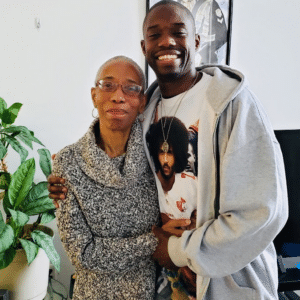
“Different” put me on a stage in Africa. It put me beside Governor Tom Wolf at press conferences to fund Pennsylvania’s Hunger Free Campus Grant Program. It carried me through my MPA and into more than 25 states. “Different” was never shameful. It was the power.
Through therapy, travel, and reading, I give grace to people who didn’t understand. They weren’t in those rooms. I chose grace over resentment. Psychologist Everett Worthington describes forgiveness as choosing charity despite harm, and meta-analyses find that forgiveness-focused counseling helps people forgive. Grace freed me to build my household.
Connection before correction
I met my step-daughter Megan when she was 18. I came in saying, “I’m your dad. Here’s what we’re going to do.” She told me it wouldn’t work. She hadn’t connected with me, so my authority was mere noise. I learned to know her first.
Megan taught me that parenthood is a privilege, not a right. Biology is not a skill set. Parenting in recovery is unnatural, because we must let children feel consequences, and connection makes that easier. And praise must be as loud as correction.
We live it. I make weekly calls to ask how her soul and therapy are doing. In a Maasai village in Africa, I learned they meet at night to talk everything through. My home now does the same. We share five gratitudes by phone. My wife Kim, our duaghter Megan, and I all take medication for mental illness, see therapists, and have fed people who are homeless together. The Substance Abuse and Mental Health Services Administration (SAMHSA) calls community “relationships and social networks that provide support, friendship, love, and hope.” Ours does.
Before I go meet Jesus
At the end of her life, my mother called me at night to talk about history and life. She always began: “Listen, there are some things I want to tell you that you need to know before I go meet Jesus.”
These are some of the lessons she shared (then and throughout my life): Connect before you correct. Let praise be at least as loud as yelling. Align the adults first. If you are a parent in recovery, start there: connect first, before the rules and the lectures.
Megan is not my biological child, and we are different races. Her Father’s Day card to me read: “I’m so proud of you and so grateful that God put you in my life. Thank you for stepping up and taking on the responsibility and the challenge of raising me!” Connection did that, not blood. It made me the family man I never had, and now I give it forward.
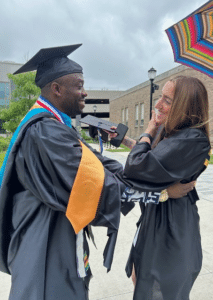
Today Megan and her partner each have more than five years sober. None of that is luck. SAMHSA defines recovery as “a process of change,” and a process is built.
Now I know better. And because I know better, I do better.