Skip to content

Workit Health Presents: A Dopey Interview of Erin Khar & Amy Dresner · Wed, Nov 4 · 7pm est · Live on YouTube

  • Treatments
    • Opioid Use Disorder

    Start Suboxone treatment online with a licensed provider without judgment.

    • Alcohol Use Disorder

    Flexible goals — moderation or abstinence. Evidence-based, no 12-step requirement

    • Kratom & 7-OH

    Medication options that actually work for withdrawals and cravings.

    Anxiety · Depression · Insomnia · Hepatitis C · And more

    Substance use often goes hand-in-hand with other conditions. Your provider can prescribe for many of these, including anxiety, depression, and insomnia—so you can get back on solid ground. They can even treat hepatitis C and prescribe PrEP for HIV prevention.

    Start treatment
  • Pricing
  • Locations

    Available now

    • Arizona
    • California
    • Florida
    • Illinois
    • Michigan
    • Montana
    • New Jersey
    • New Mexico
    • New York
    • North Carolina
    • Ohio
    • Oklahoma
    • Texas
    • Washington
    Get notified if we open in your state
  • Reviews
  • About
    • About Workit Health

    Our mission, founders, and clinical team.

    • Workit Labs · Research

     Peer-reviewed publications on telehealth addiction care.

    • Careers

    Join the team building the future of addiction care

    • Blog

    Plain language guides on recovery, medication, and family-support.

    • Podcast

    Honest conversations about addiction and recovery.

    • Member Interviews

    Real stories from real Workit Health members.

    • Please reach out—we’re here to help:
    • Hello@WorkitHealth.com
    • 855-659-7734
  • Help Someone
Login
Get started
Get started
  • Login to my account
Treatments
  • Opioid use disorder
  • Suboxone
  • Alcohol use disorder
  • Kratom & 7-OH dependency

whole person care included

Substance use often goes hand-in-hand with other conditions. Your provider can prescribe for many of these, including anxiety, depression, insomnia, hepatitis C, and more—so you can get back on solid ground.

  • Insurance or Self-pay
Locations
  • Arizona
  • California
  • Florida
  • Illinois
  • Michigan
  • Montana
  • New Jersey
  • New Mexico
  • New York
  • North Carolina
  • Ohio
  • Oklahoma
  • Texas
  • Washington
  • Get notified of new state openings →
  • Reviews
About
  • About Workit Health
  • Workit Labs · Research
  • Careers
  • Blog
  • Podcast
  • Member Interviews
  • Hello@WorkitHealth.com
  • 855-659-7734
  • Refer a friend
  • Help Someone
Get started

In crisis? Call or text: 988

Home > Blog > Connect Before You Correct: The Lesson My Mother Paid For

  • Culture, For Friends And Family

Connect Before You Correct: The Lesson My Mother Paid For

Frederick Shegog is the child of a woman in addiction recovery. Here's what she taught him about parenting in recovery before she died.

BY

  • Frederick Shegog
  • Fact-checked & medically reviewed

on this page

My mother came home from treatment and tried to take the house back. She walked in with rules and authority, and her first fight was with her father.

I heard all of it.

The conversation I wasn’t supposed to hear

My grandfather was babysitting me. When my mother came to pick me up, he asked what we were doing that night.

“I’m taking him to an AA meeting,” she said.

“Freddie,” he said, “go in the other room. The adults need to talk.”

I went, but I was a kid, and kids are curious. I turned a corner and kept listening.

“He’s not going to a meeting,” my grandfather said. “Let him be a kid. He doesn’t need to know about all those things.”

“No,” my mother said. “Why are we hiding this? If I had cancer, if I had kidney disease, if I had any medical illness, we would tell him. Growing up, we hid too much. I’m going to break that cycle with Freddie. He’s going to understand exactly who his parent is.”

“We can take him to church,” my grandfather said. “He’ll be in activities. That’s enough.”

“No,” my mother said. “We’re not having it.”

She won. I was nervous, because in my family nobody challenged an elder. We kept hard things quiet. I was watching a family cycle break. My mother, a social worker who had studied sociology, knew that silence gets handed down. Because I watched her, challenging elders never felt foreign to me.

Medicine agrees with her. In their article, Changing the Language of Addiction, Michael Botticelli and Howard Koh opened with, “Words matter.” They called addiction a chronic brain disorder and wrote that people can be effectively treated and enter recovery.

But that room is also where connection first broke. Before my mother could connect with me, she had to connect with the man helping raise me. They never did. They fought over one meeting and never built a shared way to raise a child around recovery.

You cannot connect with a child when the adults haven’t connected with each other first. John Bowlby, who founded attachment theory, called a caregiver a child’s secure base. Rules alone cannot be one. At that time, the connection and the secure base were missing from my mother’s relationship with me.

The cost of surviving

James Baldwin wrote: “Anyone who has ever struggled with poverty knows how extremely expensive it is to be poor.” My mother knew. She was a Black, single woman and a social worker in recovery, living with severe mental illness. The World Health Organization says the conditions people are born, grow, live, work, and age in shape health, and warns that “social injustice is killing people on a grand scale.” Economists report that unmarried Black women typically fare worst in wealth. Arline Geronimus calls the toll of such hardship on the body “weathering.”

The sports and programs cost money my mother had already stretched thin. AA, Alateen, and therapy didn’t cost money, but all cost time she didn’t have. She thought activities were connection. She didn’t know connection was its own act, and the world never gave her space to learn.

Why did my grandfather want to hide my mother’s addiction and recovery? I believe it was love, and a family shielding itself from judgment. Sociologist Patricia Hill Collins calls stereotypes of Black women “controlling images” that provide scripts both for how people view and treat Black women, and for how those women understand themselves. The 1965 federal report, The Negro Family: The Case for National Action, put “the weakness of the family structure” at the center of “the tangle of pathology.” Dorothy Roberts says the child welfare system targets Black mothers “for accusation and surveillance and punishment, instead of supporting them.” Together, these influences create and reinforce a protective system of unspoken, hidden struggles.

Silence can look like safety.

“Different” was the gift

Once my mother got sober, I lived in adult rooms: AA meetings, AA tapes at night, my mother reading the AA book aloud. I probably lost part of my childhood. I gained a deeper way of seeing.

People called me weird, odd, different. It hurt. I was ashamed. In The Souls of Black Folk, W.E.B. Du Bois described “this sense of always looking at one’s self through the eyes of others,” and a gift of “second-sight.”

I am no longer ashamed. Thank you, Mom, for making me different.
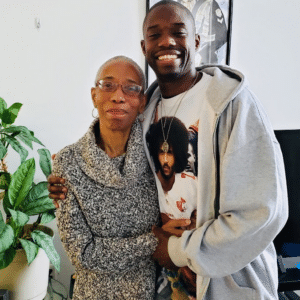
Frederick Shegog and his mother
Me and my mother at my first keynote, for the Black Student Union’s Black History Month program at Clarion University, now part of PennWest.


“Different” put me on a stage in Africa. It put me beside Governor Tom Wolf at press conferences to fund Pennsylvania’s Hunger Free Campus Grant Program. It carried me through my MPA and into more than 25 states. “Different” was never shameful. It was the power.

Through therapy, travel, and reading, I give grace to people who didn’t understand. They weren’t in those rooms. I chose grace over resentment. Psychologist Everett Worthington describes forgiveness as choosing charity despite harm, and meta-analyses find that forgiveness-focused counseling helps people forgive. Grace freed me to build my household.

Connection before correction

I met my step-daughter Megan when she was 18. I came in saying, “I’m your dad. Here’s what we’re going to do.” She told me it wouldn’t work. She hadn’t connected with me, so my authority was mere noise. I learned to know her first.

Megan taught me that parenthood is a privilege, not a right. Biology is not a skill set. Parenting in recovery is unnatural, because we must let children feel consequences, and connection makes that easier. And praise must be as loud as correction.

We live it. I make weekly calls to ask how her soul and therapy are doing. In a Maasai village in Africa, I learned they meet at night to talk everything through. My home now does the same. We share five gratitudes by phone. My wife Kim, our duaghter Megan, and I all take medication for mental illness, see therapists, and have fed people who are homeless together. The Substance Abuse and Mental Health Services Administration (SAMHSA) calls community “relationships and social networks that provide support, friendship, love, and hope.” Ours does.

Before I go meet Jesus

At the end of her life, my mother called me at night to talk about history and life. She always began: “Listen, there are some things I want to tell you that you need to know before I go meet Jesus.”

These are some of the lessons she shared (then and throughout my life): Connect before you correct. Let praise be at least as loud as yelling. Align the adults first. If you are a parent in recovery, start there: connect first, before the rules and the lectures.

Megan is not my biological child, and we are different races. Her Father’s Day card to me read: “I’m so proud of you and so grateful that God put you in my life. Thank you for stepping up and taking on the responsibility and the challenge of raising me!” Connection did that, not blood. It made me the family man I never had, and now I give it forward.

Speaking at Megan's commencement.
Speaking at Megan’s commencement.

Today Megan and her partner each have more than five years sober. None of that is luck. SAMHSA defines recovery as “a process of change,” and a process is built.

Now I know better. And because I know better, I do better.

PrevpreviousConnect Before You Correct: How the Community Got Me Through College

on this page

PrevpreviousConnect Before You Correct: How the Community Got Me Through College

ABOUT THE AUTHOR

Frederick Shegog is a National Keynote Speaker and Policy Advocate, Founder and CEO of The Message LLC. He speaks at colleges, conferences, and institutions nationwide on recovery, resilience, and human transformation. Learn more at freddyshegog.com.

ready when you are​

Download the app. Get back to yourself.

Sign up takes about 5 minutes. Most members have their first appointment within 2 days. Covered by most insurance.

Download the app
Learn more

KEEP READING

True or False: “Less Is More” When Taking Suboxone

Why do some people say a lower dose of Suboxone will work better? Is less more? Nurse practitioner Dana Forman explains the thinking behind this common myth.

Read now

5 Questions About Online Suboxone Treatment, Answered

Workit Health treats opioid addiction with medication like Suboxone online via telehealth. How do we do it? In this post, we answer several common questions.

Read now

Heroin Detox: The First Three Days Survival Guide

Ready to detox from heroin? Here’s what to expect and how to handle the cravings and physical withdrawal symptoms. Trust us, it’s worth it.

Read now

Any general advice posted on our blog, website, or app is for informational purposes only and is not intended to replace or substitute for any medical or other advice. Workit Health, Inc. and its affiliated professional entities make no representations or warranties and expressly disclaim any and all liability concerning any treatment, action by, or effect on any person following the general information offered or provided within or through the blog, website, or app. If you have specific concerns or a situation arises in which you require medical advice, you should consult with an appropriately trained and qualified medical services provider.

100% virtual addiction treatment for opioid, alcohol, and kratom use disorders. Evidence-based care including prescriptions, recovery support, and community—from your phone.

Please reach out. We’re here to help:
hello@workithealth.com
855-659-7734

Linkedin-in Instagram Facebook-f Youtube Spotify Podcast
    • TREATMENTS
    • Opioids
    • Kratom & 7-OH
    • Alcohol
    • Insurance & Cost
    • Locations
    • Get started
    • HELP SOMEONE
    • Help a loved one
    • Refer a friend
    • Recovery blog
    • Narcan guide
    • COMPANY
    • About
    • Workit Labs · Research
    • Careers
    • Partnerships
    • Request Info
      • MEMBERS
      • Login
      • Create account
      • Refer a friend
      • Medical records request form
      • Fax: 833-923-0584
AICPA SOC
  • 42 CFR Part 2
  • WCAG 2.1 AA

contact information

Arizona
2501 N Hayden Rd.
Ste 103
Scottsdale, AZ 85257
fax (HIPAA): (833) 664-5441

California
1460 Maria Lane
Ste 300
Walnut Creek, CA 94596
fax (HIPAA): (833) 244-6705

Florida
600 Heritage Dr.
Ste 210, #17
Jupiter, FL 33458
fax (HIPAA): (813) 200-2822

Illinois
1280 Iroquois Ave
Ste 402
Naperville, IL 60563
fax (HIPAA): (833) 664-8715

Michigan
3300 Washtenaw Ave
Ste 280
Ann Arbor, MI 48104
fax (HIPAA): (855) 716-4494

Montana
415 N Higgins Ave
Ste 6
Missoula, MT 59802
fax (HIPAA): (833) 664-5486

New Jersey
5 Greentree Center
Ste 117
Marlton, NJ 08053
fax (HIPAA): (609) 855-5027

New Mexico
5901 Indian School Road, NE
Ste 212
Albuquerque, NM 87110
fax (HIPAA): (833) 664-5701

New York
845 Central Avenue
Ste 204
Albany, NY 12206
fax (HIPAA): (844) 921-1079

North Carolina
3719 Latrobe Drive
Ste 850-M
Charlotte, NC 28211-4827
fax (HIPAA): (984) 375-6710

Ohio
6855 Spring Valley Dr
Ste 110
Holland, OH 43528
fax (HIPAA): (513) 823-3247

Oklahoma
1010 24th Ave NW
Suite 100
Norman, OK 73069
fax (HIPAA): (833) 672-3125

Texas
5373 W Alabama St
Ste 204
Houston, TX 77056
fax (HIPAA): (737) 738-5046

Washington
9116 Gravelly Lake Dr SW
Ste 107 #3, PMB 1963
Lakewood, WA 98499-3148.
fax (HIPAA): (833) 328-1407

suboxone risk & concerns

Suboxone (buprenorphine/naloxone) is indicated for the treatment of opioid dependence in adults. Suboxone should not be taken by individuals who have been shown to be hypersensitive to buprenorphine or naloxone as serious adverse reactions, including anaphylactic shock, have been reported. Taking Suboxone (buprenorphine/naloxone) with other opioid medicines, benzodiazepines, alcohol, or other central nervous system depressants can cause breathing problems that can lead to coma and death. Other side effects may include headaches, nausea, vomiting, constipation, insomnia, pain, increased sweating, sleepiness, dizziness, coordination problems, physical dependence or abuse, and liver problems. For more information about Suboxone (buprenorphine/naloxone) see Suboxone.com, the full Prescribing Information, and Medication Guide, or talk to your healthcare provider. You are encouraged to report negative side effects of drugs to the FDA. Visit www.fda.gov/medwatch or call 1-800-FDA-1088.

© 2026 Workit Health. All rights reserved.
Privacy Policy

Notice of Privacy Practices

Terms of Service

View Accessibility Statement

All clinical and medical services are provided by licensed physicians and clinicians who are practicing as employees or contractors of independently owned and operated professional medical practices that are owned by licensed physicians. These medical practices include Workit Health (MI), PLLC; Workit Health (CA), P.C.; Workit Health (NJ), LLC; Workit Health (OH), LLC; Virtual Physician Practice (NY), PLLC; and any other Workit Health professional entity that is established in the future.

Not ready to start? We'll send you more information:

  • Workit Health

    When I opt in, Workit Health will send information about their program and recovery resources.

    *I agree to receive marketing and member care messages by email. Messaging frequency varies. I can unsubscribe at any time.

    **I agree to receive marketing and member care messages by text (SMS). Messaging frequency varies. Message and data rates may apply. I can opt out at any time by replying STOP. I can reply HELP to receive support. If I do not consent to receive SMS, and Workit Health is unable to reach me by email, I understand that they will not be able to contact me by text.

    Carriers are not liable for delayed or undelivered messages.

    View our Privacy Policy, Terms of Service, and Consent to SMS and Email.

  • Should be Empty:
cookie icon

We use cookies

This site uses cookies to improve your experience. By using this site, you consent to our use of cookies.